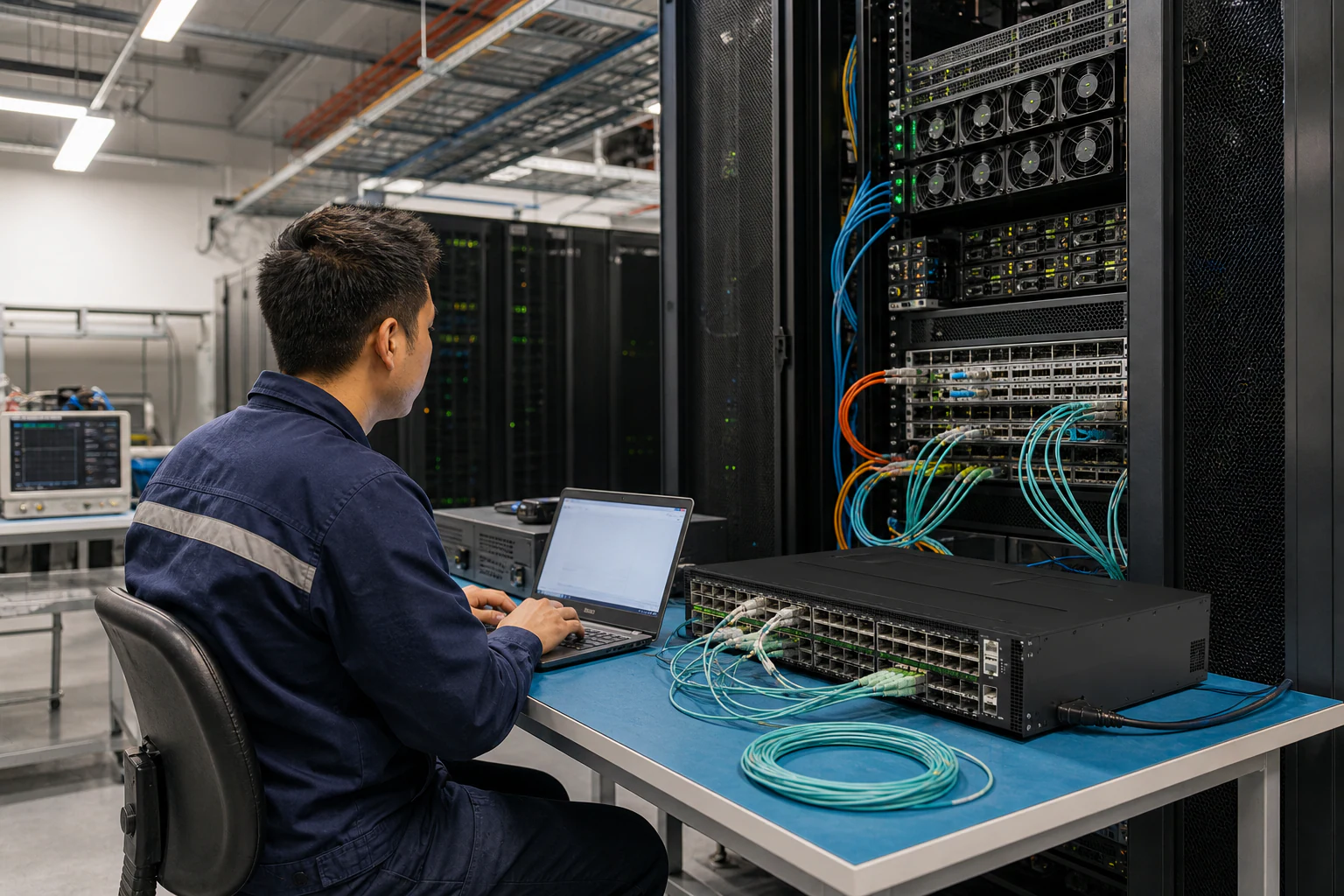
In brief
Engineering guide for AI fabric buyers covering RoCE, SONiC, telemetry, optics, support ownership, and deployment validation.
Key takeaways
- Australian data center operators building AI training and inference clusters face a critical networking decision: the backend fabric that connects GPU nodes determines cluster utilization, training throughput, and cost per workload.
- GPU clusters rely on high-bandwidth, low-latency east-west communication for operations such as gradient exchange, parameter synchronization, model parallelism, distributed storage access, and checkpoint movement.
- For Australian buyers, the design question is not only technical. It affects data sovereignty planning, local support coverage, optics sourcing, power and cooling allocation, and the ability to expand clusters across future refresh cycles.
The GPU Backend Fabric Is the New Network Bottleneck
Australian data center operators building AI training and inference clusters face a critical networking decision: the backend fabric that connects GPU nodes determines cluster utilization, training throughput, and cost per workload. Once GPU servers are deployed, poor fabric design shows up as stalled collectives, uneven job completion, microburst loss, and expensive accelerators waiting on the network.
GPU clusters rely on high-bandwidth, low-latency east-west communication for operations such as gradient exchange, parameter synchronization, model parallelism, distributed storage access, and checkpoint movement. These flows are sensitive to packet loss and tail latency. A fabric that is acceptable for ordinary server traffic can become the bottleneck for AI workloads.
For Australian buyers, the design question is not only technical. It affects data sovereignty planning, local support coverage, optics sourcing, power and cooling allocation, and the ability to expand clusters across future refresh cycles. The backend fabric should therefore be evaluated as infrastructure, not as a one-off switch purchase.
Why RoCE v2 Is Challenging InfiniBand on the Backend
InfiniBand has traditionally been the default backend option for many high-performance GPU clusters because it provides native RDMA semantics, mature congestion handling, and a tightly integrated ecosystem. That remains a strong option for workloads that are already standardized on InfiniBand tooling and support.
RoCE v2 brings RDMA semantics to Ethernet by carrying RDMA traffic over UDP/IP. This lets operators use Ethernet switching, Ethernet optics, IP addressing, and familiar data center operations while still targeting low-latency, high-throughput transport for GPU backend traffic. The trade-off is that RoCE v2 depends on correct lossless Ethernet design and careful validation.
The economic case is straightforward: Ethernet has a broad vendor ecosystem, a large optics supply chain, and a deep operations talent pool. For organizations that want NOS choice, multi-vendor sourcing, and a path from 400G to 800G, RoCE v2 over Ethernet is increasingly part of the evaluation.
| Factor | InfiniBand | RoCE v2 over Ethernet |
|---|---|---|
| RDMA support | Native | Native (RoCE v2) |
| Common high-speed design point | 400G and higher, depending on platform generation | 400G and 800G Ethernet designs, depending on platform generation |
| Lossless fabric | Credit-based flow control | PFC + ECN + DCBX |
| Ecosystem breadth | Strong integrated stack | Broad Ethernet vendor ecosystem |
| NOS options | Typically platform-specific | SONiC and other Ethernet NOS options |
| Buyer focus | Performance, integration, support model | Performance, openness, supply chain, operations model |
400G and 800G: The Speed Tiers Defining AI Fabric Design
400G is a practical design point for many current GPU backend fabrics because it aligns with modern NICs, switch ASICs, and QSFP-DD optics. It is also familiar enough that Australian data center teams can source optics, cables, and engineering support with less deployment risk than early-stage speed transitions.
800G is becoming important for next-generation AI fabrics where rack density, cluster scale, and oversubscription targets require more capacity per port. Buyers should treat 800G readiness as both a switching question and an optics question. OSFP and QSFP-DD form factors, cable reach, thermal budgets, and local supply availability can influence the final design as much as switch throughput.
Most AI backend fabrics use a spine-leaf or rail-optimized topology. Server-facing links may be 100G, 200G, 400G, or 800G depending on GPU NIC generation, while spine links are sized to keep collective traffic from oversubscribing the backend. The best design is workload-specific: training, inference, storage-heavy pipelines, and mixed tenant clusters each stress the fabric differently.
The SONiC Advantage: Open NOS for GPU Backend Switches
SONiC (Software for Open Networking in the Cloud) is an open-source network operating system based on Linux and governed through the SONiC Foundation under the Linux Foundation. It runs across multiple switch vendors and ASIC families through the Switch Abstraction Interface, which helps separate the NOS from the underlying silicon.
For GPU backend fabrics, SONiC gives Australian operators a way to evaluate high-speed Ethernet switching without accepting a single-vendor NOS dependency. The value is not simply that the software is open source. It is that teams can standardize configuration, telemetry, automation, and operational tooling across a broader set of hardware choices.
Lossless Ethernet Essentials: DCBX, PFC, ECN, and Fast CNP
RoCE v2 requires a carefully engineered lossless Ethernet profile. The core mechanisms are:
- DCBX (Data Center Bridging Capability Exchange): Exchange of data center bridging parameters between adjacent devices so the fabric and NICs agree on lossless classes.
- PFC (Priority Flow Control): Per-priority pause behavior that protects RDMA traffic classes from packet drops during congestion.
- ECN (Explicit Congestion Notification): Congestion signaling that lets endpoints reduce sending rate before packet loss occurs.
- Fast CNP (Congestion Notification Packet): A congestion response approach used in some AI fabric designs to reduce reaction time and improve tail latency.
The difficult part is not enabling each feature. The difficult part is validating buffer profiles, pause behavior, ECN thresholds, queue mapping, and failure cases under realistic GPU traffic. A fabric that passes basic link testing can still underperform when collective workloads create synchronized bursts.
Telemetry and Visibility: INT and IPTPath for AI Fabric Operations
AI cluster operators need per-flow and per-hop visibility into congestion, latency, queue depth, drops, and path changes. In-band Network Telemetry and path telemetry can help by exposing forwarding behavior across the fabric instead of relying only on end-host symptoms.
For xSONiC planning, INT telemetry and IPTPath telemetry should be reviewed alongside RoCE v2 design. Telemetry is what turns a high-speed fabric from a black box into an operational system that can be tuned, debugged, and expanded.
The Australian Buyer Checklist for GPU Backend Fabric Design
Australian data center operators evaluating GPU backend fabrics should work through the following checklist before procurement:
- Cluster scale: How many GPU nodes? Single rack (8-32 GPUs) vs multi-rack (64-1024+ GPUs) vs pod-scale.
- NIC choice: Which NIC generation, link speeds, and RoCE features are required by the target GPU servers?
- Speed tier: 400G today, 800G readiness for the next refresh cycle.
- NOS strategy: Proprietary NOS lock-in vs SONiC-based open networking.
- Lossless fabric configuration: DCBX + PFC + ECN + Fast CNP baseline.
- Telemetry: INT and IPTPath for proactive congestion detection.
- Optical planning: QSFP-DD 400G and OSFP 800G transceiver sourcing in Australia.
- Vendor support: Local engineering support, integration services, spare logistics.
The checklist should be paired with lab validation. A credible pilot should include throughput testing, congestion testing, link failure testing, warm reboot behavior, telemetry validation, and operational runbooks for common failure scenarios.
What This Means for xSONiC Buyers in Australia
The GPU backend fabric decision is shifting from a default InfiniBand assumption toward a deliberate RoCE v2 over Ethernet evaluation. InfiniBand remains a strong option, but 400G and 800G Ethernet with SONiC-based switching can offer compelling operational flexibility, a broader supply chain, and better alignment with existing Ethernet skills.
xSONiC’s data center AI switch portfolio and GPU backend fabric guidance give Australian buyers a practical evaluation path for RoCE v2 fabrics. For teams planning a cluster, the right next step is not only selecting port speeds. It is validating the complete system: switches, optics, NICs, DCB configuration, telemetry, automation, and support.
This article is part of xSONiC’s AI Fabric buyer education series. For a GPU backend fabric consultation, contact xSONiC.
Engineering FAQ
How should NVMe form factor selection be made? Start with workload profile, usable capacity, serviceability, thermal envelope, write endurance, PCIe generation, slot layout, and replacement process. U.2, E1.S, M.2, and AIC devices solve different mechanical and operational problems.
What matters more than peak sequential speed? Sustained performance, thermal throttling behaviour, write endurance, latency under load, firmware stability, power-loss protection, and fleet manageability usually matter more than a single benchmark number.
How should storage be validated for AI or cloud workloads? Test the selected form factor in the real chassis with expected airflow, queue depth, write mix, temperature range, and monitoring stack. Validation should include steady-state and recovery behaviour, not only fresh-drive performance.
Related xSONiC Resources
Sources Reviewed
- RoCE GPU Backend Fabrics Reference
- AI Fabric Ethernet Reference
- Ethernet Network Adapters - ConnectX NICs | NVIDIA
- NVIDIA BlueField Data Processing Unit
- NVIDIA Spectrum-X Ethernet Platform
- SONiC Project Documentation
- Broadcom Ethernet Switching
- Marvell Switching
- NVIDIA Ethernet Switching
- Open Compute Networking
- SONiC GitHub
- SONiC Foundation
- Supports: SONiC governance, architecture, and open networking context.
- Supports: SONiC platform, container architecture, and multi-vendor NOS context.
- Supports: AI Ethernet switching and high-speed fabric context.
- Supports: ECN congestion signaling background.
- Supports: PFC background for lossless Ethernet designs.
Product fit
Products referenced for evaluation
These products are referenced for evaluation context in the article. Confirm workload, port, optics, software, interoperability, and support requirements against the exact deployment before procurement.
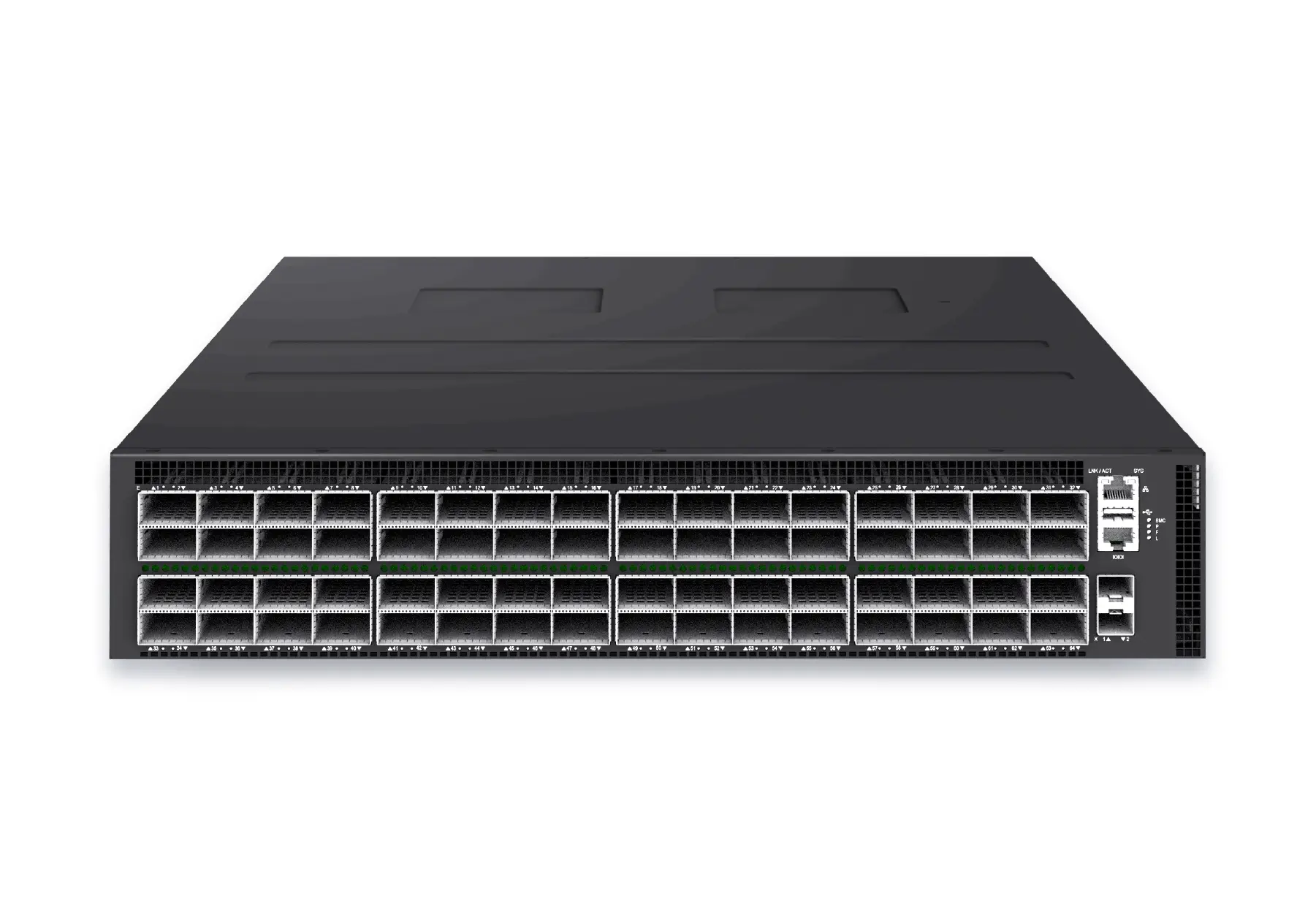 datacenter aiXS-DC-64X800-AI-G164-port 800G AI fabric switch for large-scale GPU clusters, HPC backbones, and ultra-high-throughput data center networks.View product
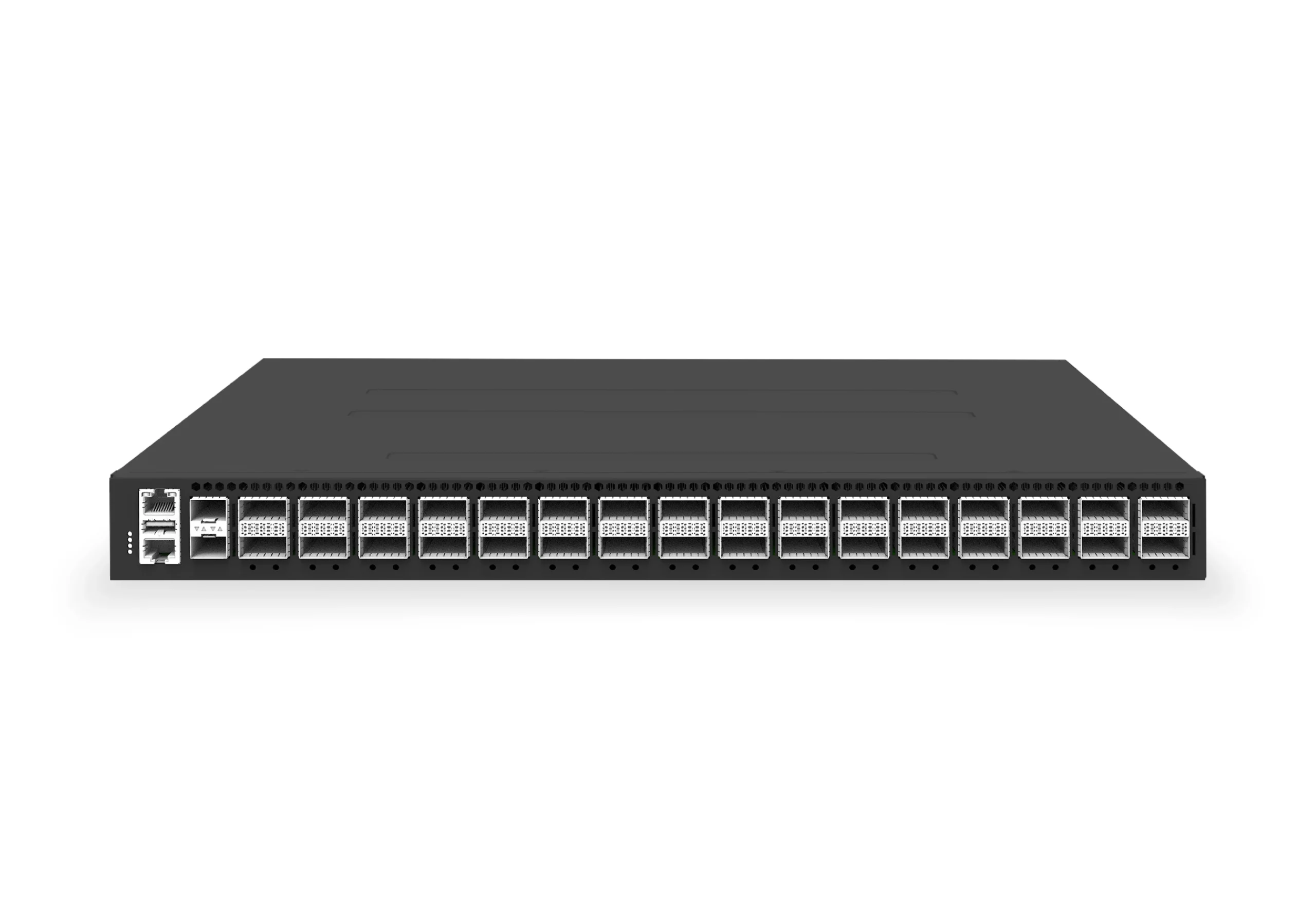 datacenter aiXS-DC-32X400-SP-G232-port 400G spine/core switch for high-capacity data center fabrics and AI-ready backbones.View product
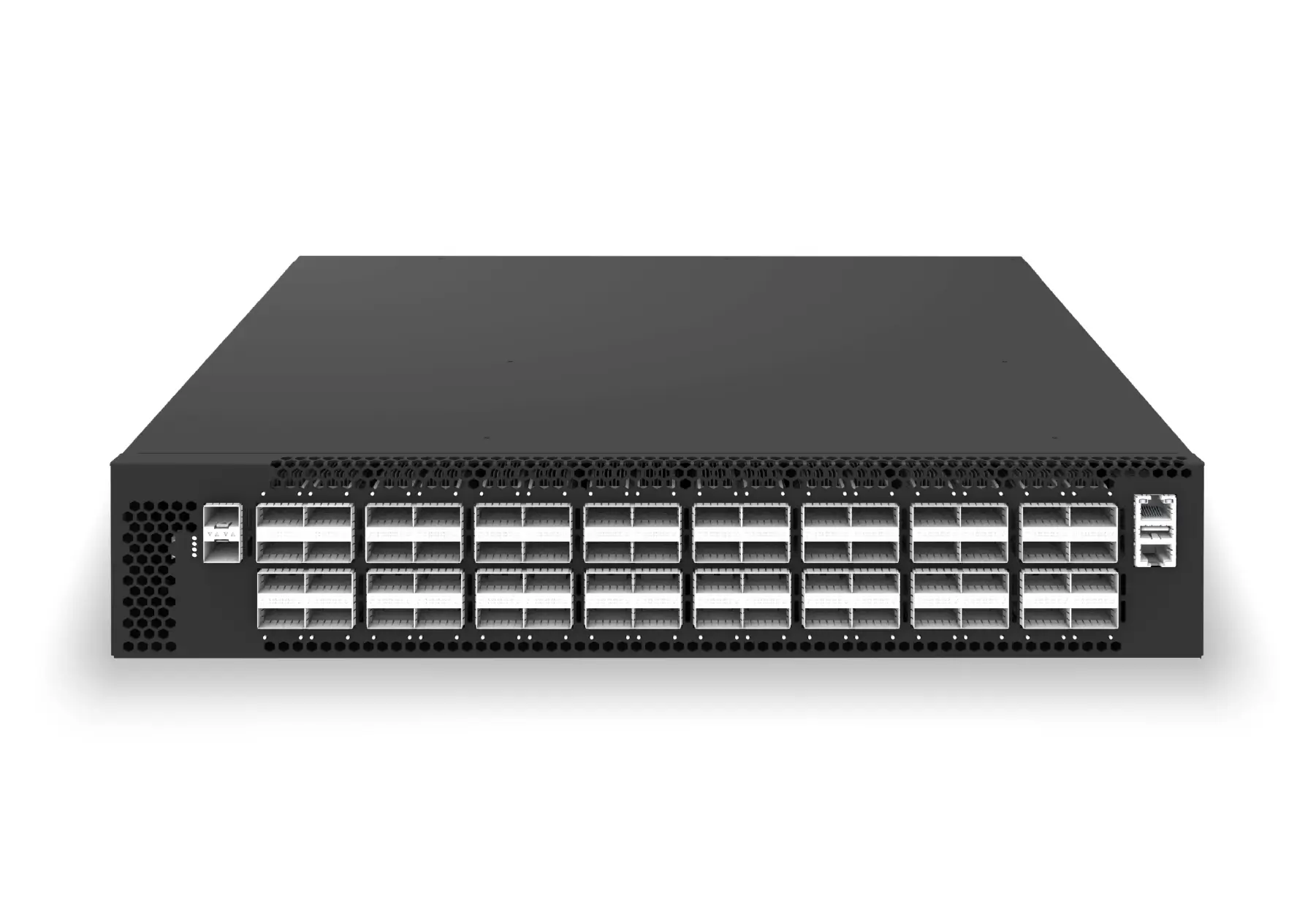 datacenter aiXS-DC-64X200-LS-G164-port 200G leaf/spine switch for high-bandwidth storage, compute, and scale-out data center fabrics.View product
Continue reading
Related articles
 Technical ArticleHow SONiC-Powered 400G and 800G Switches Change AI Data Center Fabric Design in AustraliaEngineering guide for 400G and 800G optics planning covering form factor, reach, telemetry, thermal limits, supply risk, and validation.Read article
 Technical ArticleWhat Australian Data Center Buyers Need to Know Before Choosing SONiC Switches for 400G and 800G UpgradesEngineering guide for 400G and 800G optics planning covering form factor, reach, telemetry, thermal limits, supply risk, and validation.Read article
 Technical ArticleRoCE RDMA and Lossless Ethernet Fabric Design: What AI Cluster Buyers Need to KnowEngineering guidance on RoCE RDMA and Lossless Ethernet Fabric Design for Australian AI fabric teams, covering RoCE validation, congestion control, telemetry, optics.Read article