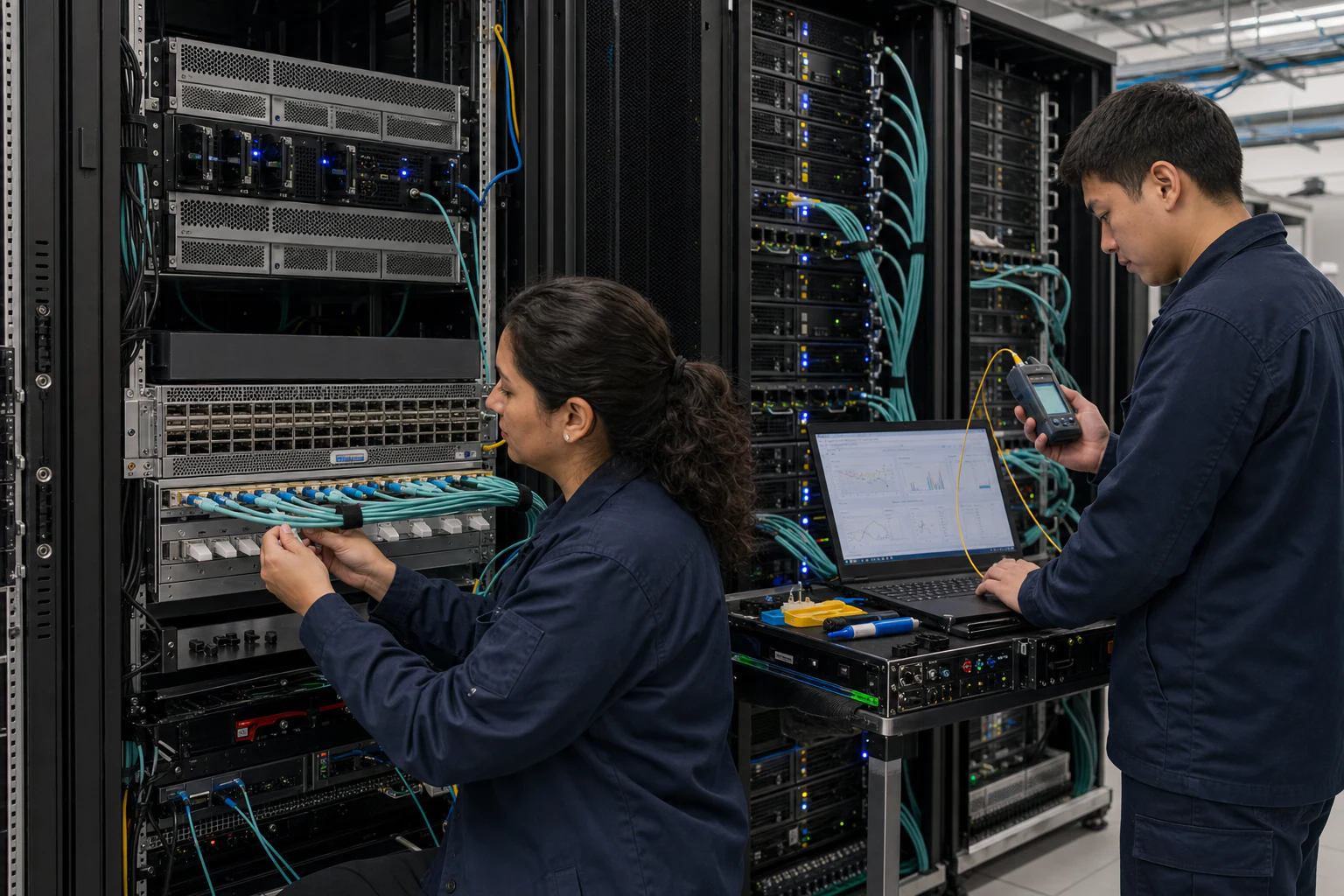
In brief
Engineering guidance on AI Data Center Ethernet Switching on SONiC for Australian network teams, covering underlay design, EVPN-VXLAN operations, interoperability.
Key takeaways
- Software for Open Networking in the Cloud (SONiC) is a free and open-source network operating system built on Linux that runs on switches from multiple vendors and ASICs.
- For Australian organizations building AI and machine learning infrastructure, SONiC presents a compelling alternative to proprietary switching stacks.
- This guide walks through the technical requirements, decision criteria, and deployment checklists you need to plan an AI data center fabric on SONiC, with specific attention to Australian market considerations such as local supplier availability and data sovereignty requirements.
Why SONiC for AI Data Center Switching
Software for Open Networking in the Cloud (SONiC) is a free and open-source network operating system built on Linux that runs on switches from multiple vendors and ASICs. Originally developed and production-hardened inside the data centers of major cloud service providers, SONiC offers a full suite of network functionality including BGP and RDMA that large-scale operators depend on daily. Its container-based architecture decomposes each network function into its own Docker container, providing better fault isolation, easier debugging, simplified upgrades, and enhanced scalability compared to monolithic switch OS designs.
For Australian organizations building AI and machine learning infrastructure, SONiC presents a compelling alternative to proprietary switching stacks. The SONiC Foundation, a Linux Foundation project, oversees the ecosystem with a growing community of contributors and hardware partners. The key benefits for AI data center buyers include:
- Hardware and software decoupling through the Switch Abstraction Interface (SAI), which accelerates hardware innovation and prevents vendor lock-in.
- Standard Linux interfaces and tooling, which lowers the learning curve for teams already managing Linux servers.
- Production-proven RDMA over Converged Ethernet (RoCE) support, critical for GPU-to-GPU communication in distributed AI training.
- Multi-vendor ASIC support, enabling buyers to evaluate switching silicon on merit rather than being tied to a single vendor ecosystem.
This guide walks through the technical requirements, decision criteria, and deployment checklists you need to plan an AI data center fabric on SONiC, with specific attention to Australian market considerations such as local supplier availability and data sovereignty requirements.
AI Fabric Architecture Requirements
AI training and inference workloads impose specific network requirements that differ significantly from traditional enterprise or cloud data center traffic patterns. Understanding these requirements is the foundation of a successful SONiC deployment.
Traffic Pattern Characteristics
AI/ML clusters generate predictable, high-bandwidth east-west traffic flows. During distributed training, GPU nodes exchange gradient synchronization data in large, sustained bursts. Inference workloads produce more variable traffic but still demand consistent low latency. The network must handle:
- Sustained high throughput (100G, 400G, or 800G per link) between compute nodes
- Low and predictable tail latency (p99.9) to avoid GPU idle time
- Lossless transport for RoCE v2 to prevent RDMA transaction failures
- Burst absorption capacity without packet drops
- High fan-in/fan-out ratios at spine switches
Spine-Leaf Topology
The standard architecture for AI data center fabrics is a two-tier (or three-tier for very large clusters) spine-leaf topology. Each leaf switch connects to every spine switch, providing predictable hop counts and equal-cost multipath (ECMP) routing. SONiC supports BGP-based underlay routing and EVPN-VXLAN overlay for this topology.
Scale Planning Considerations
| Cluster Size | GPU Count | Leaf Switches | Spine Switches | Uplink Speed | Typical ASIC |
|---|---|---|---|---|---|
| Small (1-2 racks) | 8-64 | 2-4 | 2 | 100G/400G | Spectrum-2 class |
| Medium (4-8 racks) | 64-256 | 4-16 | 4-8 | 400G | Spectrum-3/4 class |
| Large (16+ racks) | 256-1000+ | 16-64+ | 8-32+ | 400G/800G | Spectrum-4/6 class |
| Hyperscale | 1000+ | 64+ | 32+ | 800G | Spectrum-6 class |
Note: The ASIC class references above are based on publicly available NVIDIA Spectrum switch family specifications showing port speeds up to 800 Gb/s and throughputs up to 409.6 Tb/s in current generation hardware. Actual xSONiC platform specifications must be confirmed separately.
Key Decision Criteria
- What is your target GPU count and expected cluster growth?
- What training framework interconnect bandwidth does your AI workload require?
- Do you need 100G, 400G, or 800G leaf-to-server connectivity?
- What is your rack power and cooling budget per switch?
- Will you run a flat L3 fabric or an EVPN-VXLAN overlay?
For detailed fabric design patterns, see the xSONiC AI Fabric and GPU Backend Fabric solution guides.
Switching Silicon and Platform Selection Checklist
Selecting the right switching silicon is the most consequential hardware decision for an AI data center fabric. SONiC’s hardware abstraction through SAI means you are not locked into one ASIC vendor, but the maturity of SAI implementations varies across platforms.
ASIC Evaluation Checklist
Use this checklist when evaluating switches for your SONiC AI fabric:
- SAI maturity: Does the ASIC have a production-grade SAI implementation? Check the SONiC supported devices list for current compatibility status.
- Port speed: Does the platform support your target server-facing speed (100G, 400G, or 800G)?
- Port density: How many ports at your target speed does the switch provide? Does it match your rack server count?
- Buffer depth: Deep buffers are critical for burst absorption in AI workloads. What is the per-port and shared buffer size?
- RoCE v2 support: Does the ASIC support hardware-level RoCE v2 with DCBX, PFC (Priority Flow Control), and ECN (Explicit Congestion Notification)?
- RDMA counters and telemetry: Does the platform expose per-queue RDMA statistics, INT (In-band Network Telemetry), and congestion visibility?
- ECMP scale: What is the maximum ECMP group size and route table depth?
- Latency: What is the published cut-through switching latency?
- Forwarding rate: What is the total packets-per-second forwarding capacity?
- Power consumption: What is the typical power draw in watts per rack unit?
- SONiC version compatibility: Which SONiC release versions are validated for this platform?
- Hot-swap and redundancy: Does the platform support redundant power supplies, fan modules, and management planes?
Platform Tier Reference
Based on publicly available vendor specifications, current-generation Ethernet switching platforms for AI workloads span these general tiers:
| Tier | Use Case | Port Speed | Example ASIC Class | Max Throughput |
|---|---|---|---|---|
| Entry | Lab/dev, small inference | 100G | Spectrum-2 class | ~6.4 Tb/s |
| Mid | Medium training cluster | 100G-400G | Spectrum-3 class | ~12.8 Tb/s |
| Production | Large training + inference | 400G-800G | Spectrum-4 class | ~51.2 Tb/s |
| Hyperscale | Multi-rack AI factory | 800G | Spectrum-6 class | ~102.4-409.6 Tb/s |
Important: These throughput figures are drawn from publicly documented NVIDIA Spectrum switch specifications. xSONiC platform specifications may differ and must be confirmed with the xSONiC product team before procurement.
Australian Market Considerations
- Confirm that your chosen switch platform has Australian distribution and local RMA/swap support.
- Verify lead times, which can extend significantly for newer ASIC generations.
- Evaluate whether the vendor offers local technical pre-sales engineering for SONiC-specific deployments.
- Check data sovereignty requirements: does any management or telemetry data leave Australia?
RoCE v2 and Lossless Ethernet Configuration
RDMA over Converged Ethernet version 2 (RoCE v2) is the transport mechanism that enables GPU-to-GPU direct memory access across the network. For AI training clusters, RoCE v2 is not optional; it is the foundation of distributed training performance. Configuring it correctly on SONiC requires several interdependent features working together.
The Lossless Ethernet Stack
RoCE v2 requires a lossless Ethernet fabric to prevent RDMA transaction failures. This is achieved through a combination of:
-
Priority Flow Control (PFC): IEEE 802.1Qbb PFC allows a receiving switch to pause a specific traffic priority without affecting other priorities. This prevents buffer overflows for RDMA traffic.
-
Data Center Bridging Capability Exchange (DCBX): DCBX negotiates PFC and other DCB parameters between switches and endpoints automatically. See the xSONiC DCBX Technology guide for implementation details.
-
Explicit Congestion Notification (ECN): ECN marks packets during congestion rather than dropping them. The sender reduces its rate in response to ECN marks.
-
Fast Congestion Notification and Processing (Fast CNP): Fast CNP accelerates the congestion response loop, reducing the time between congestion detection and rate reduction. This is particularly important for AI training traffic that can cause micro-burst congestion. See Fast CNP for technical deep-dive.
SONiC RoCE v2 Configuration Checklist
- Buffer pool allocation: Configure dedicated buffer pools for RDMA traffic class. Set xoff andxon thresholds appropriate for your link speed and cable length.
- PFC enablement: Enable PFC on the priority assigned to RoCE v2 traffic (typically priority 3 or 4). Verify PFC negotiation with DCBX.
- ECN configuration: Configure WRED (Weighted Random Early Detection) with ECN marking thresholds. Set min-threshold and max-threshold based on your buffer depth and target latency.
- Queue scheduling: Configure strict priority queuing for the RDMA traffic class. Ensure best-effort traffic does not starve RDMA queues.
- Cable length compensation: Adjust PFC watchdog timers and buffer thresholds based on actual cable lengths in your deployment. Longer cables require larger buffers to avoid pause frame starvation.
- PFC deadlock prevention: Configure PFC watchdog timers to detect and recover from PFC deadlock scenarios where two switches pause each other indefinitely.
- RoCE v2 QoS mapping: Ensure DSCP values from GPU NICs map correctly to the switch QoS policy. Verify end-to-end DSCP trust boundary.
- Verification: Run RoCE v2 connectivity tests between sample GPU nodes. Verify zero RDMA transaction errors under load.
For comprehensive RoCE v2 implementation guidance, see the xSONiC RoCE v2 Guide.
Engineering FAQ
What should be proven before adopting EVPN-VXLAN on SONiC? Prove underlay routing, BGP sessions, VTEP behaviour, MAC/IP learning, route scale, multi-homing design, failure convergence, and observability. The overlay should be accepted as a system, not a feature checkbox.
Why does the underlay design still matter in an overlay network? EVPN-VXLAN depends on a stable routed underlay. MTU, ECMP, addressing, route policy, link failure behaviour, and telemetry determine whether the overlay remains predictable under load and during faults.
What should be included in an EVPN-VXLAN operations runbook? Include naming, IP plan, BGP policy, VNI mapping, change process, rollback commands, failure checks, telemetry fields, backup and restore steps, and escalation ownership for the selected SONiC image.
Related xSONiC Resources
Sources Reviewed
- Ethernet Network Adapters - ConnectX NICs | NVIDIA
- NVIDIA BlueField Data Processing Unit
- NVIDIA Spectrum-X Ethernet Platform
- ACSC Essential Eight
- OAIC Notifiable Data Breaches
- APRA CPS 234 Information Security
- NETSCOUT Network Packet Definition
- Cloudflare Network Packet Definition
- SONiC Project Documentation
- Broadcom Ethernet Switching
- Marvell Switching
- NVIDIA Ethernet Switching
- Open Compute Networking
- SONiC GitHub
- SONiC Foundation
Product fit
Products referenced for evaluation
These products are referenced for evaluation context in the article. Confirm workload, port, optics, software, interoperability, and support requirements against the exact deployment before procurement.
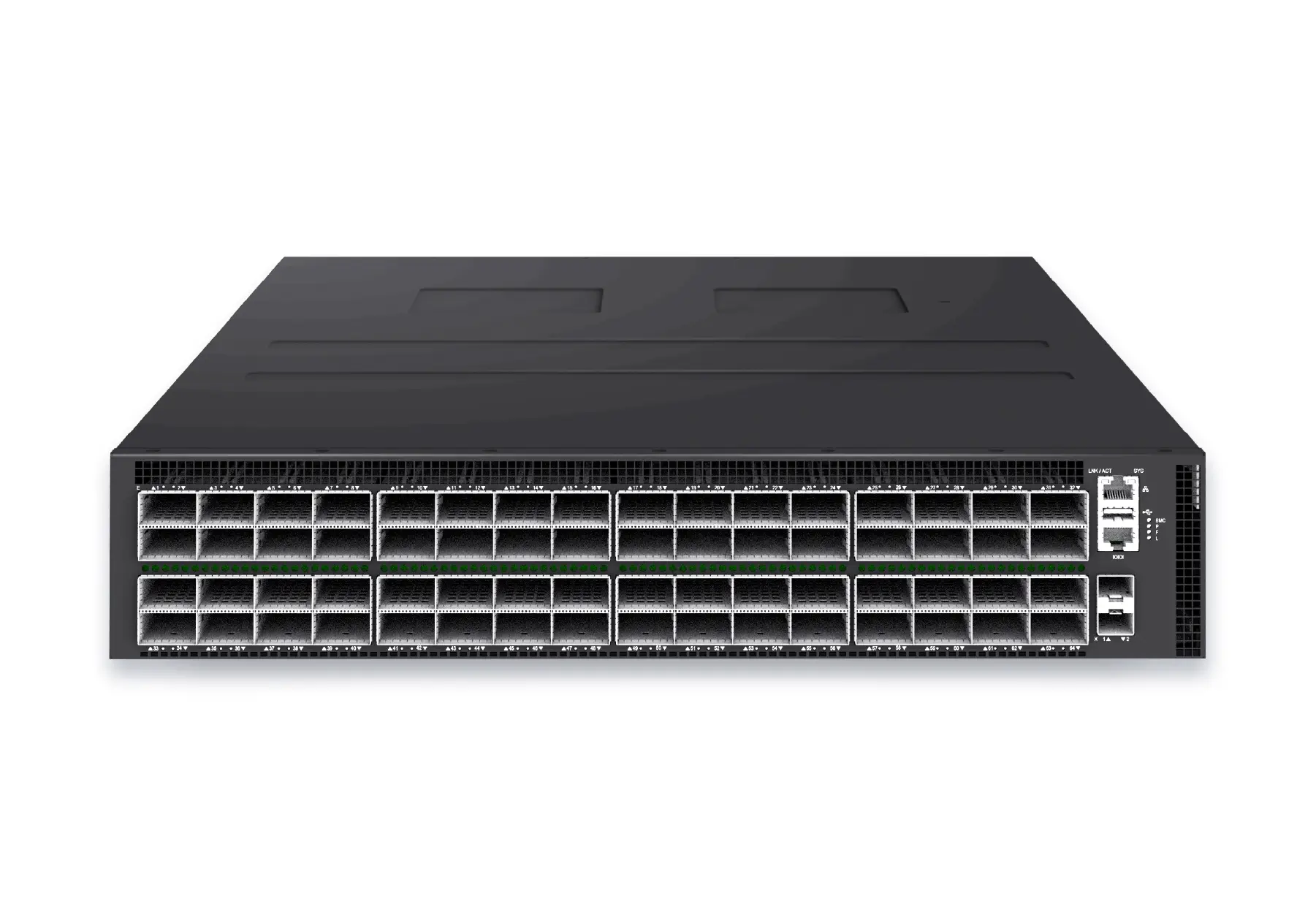 datacenter aiXS-DC-64X800-AI-G164-port 800G AI fabric switch for large-scale GPU clusters, HPC backbones, and ultra-high-throughput data center networks.View product
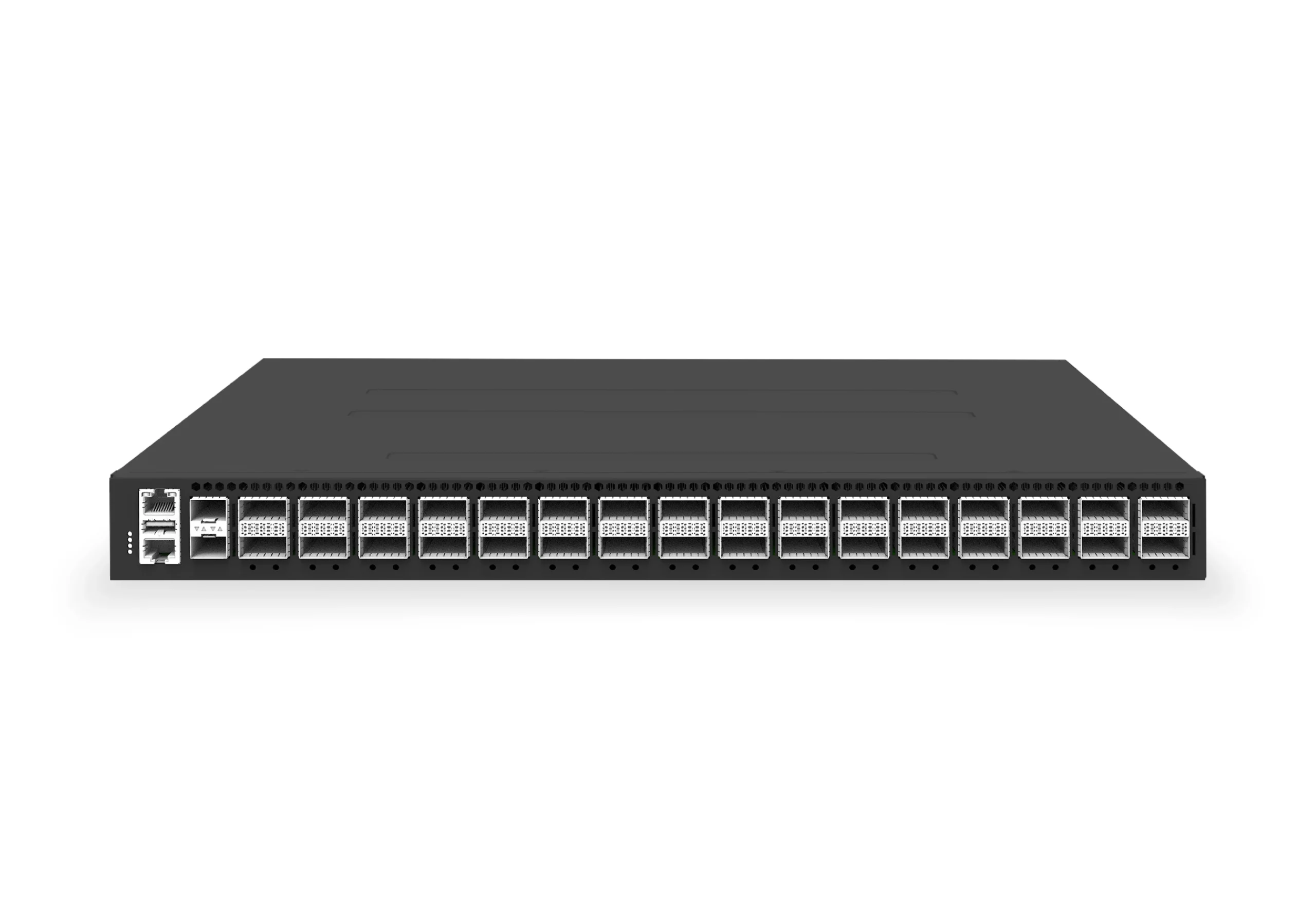 datacenter aiXS-DC-32X400-SP-G232-port 400G spine/core switch for high-capacity data center fabrics and AI-ready backbones.View product
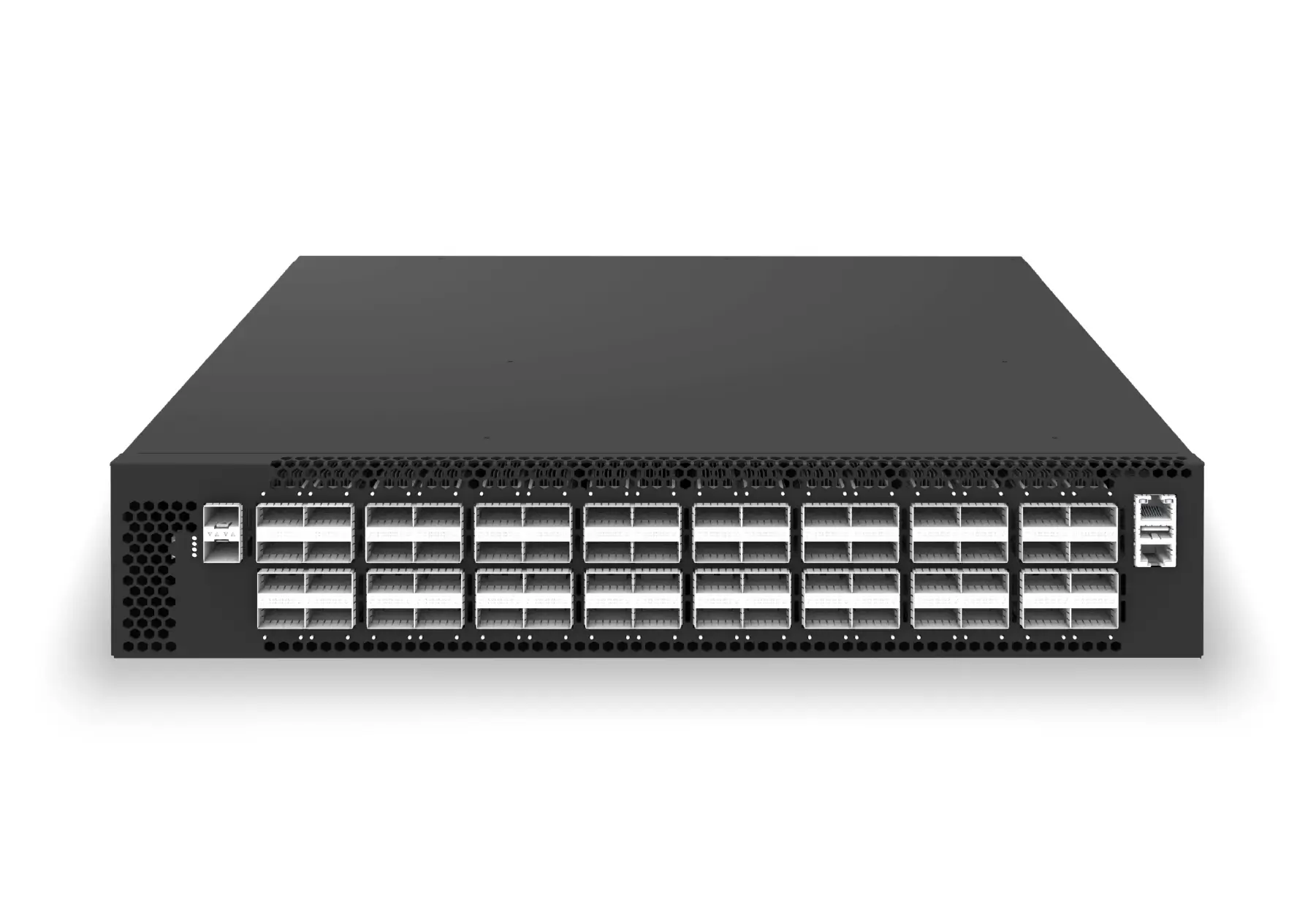 datacenter aiXS-DC-64X200-LS-G164-port 200G leaf/spine switch for high-bandwidth storage, compute, and scale-out data center fabrics.View product
Continue reading
Related articles
 Technical ArticleOpen Networking Support for Enterprise Buyers: How SONiC and Open NOS Models Actually WorkEngineering guidance on Open Networking Support for Enterprise Buyers for Australian campus teams, covering PoE budgets, access-layer resilience, migration risk.Read article
 Technical ArticleFrom Proprietary Lock-In to Open Networking: A Practical Enterprise SONiC Migration PlaybookA practical Enterprise SONiC migration playbook for Australian buyers moving from proprietary switch OS to open networking.Read article
 Technical ArticleWhy Centralized AI Fabric Management Is the Missing Layer in Open NetworkingEngineering guidance on Centralized AI Fabric Management Is the Missing Layer in Open Networking for Australian network teams, covering underlay design, EVPN-VXLAN.Read article