In brief
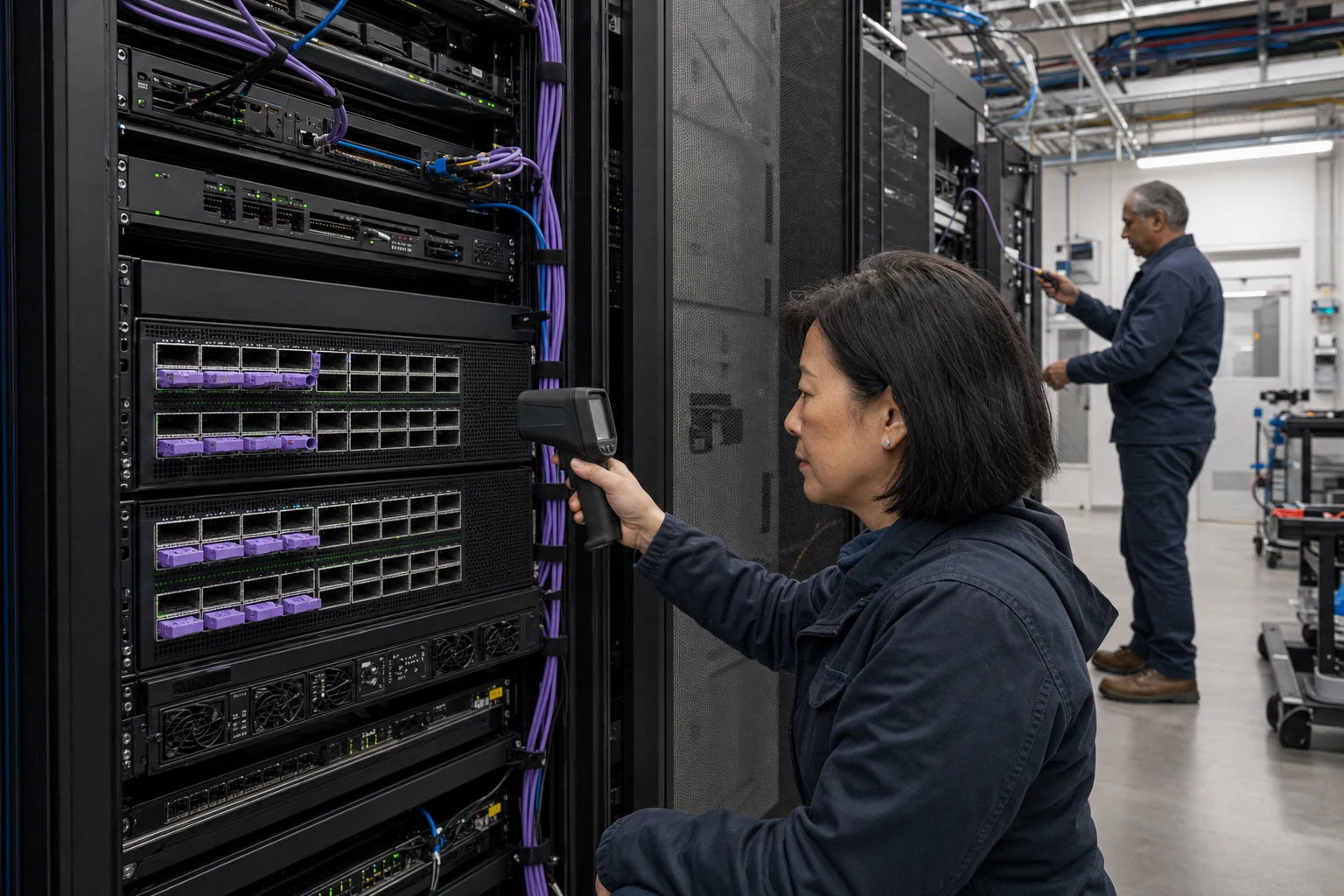
A practical engineering analysis of why AI workloads change Ethernet switching requirements, covering RoCE v2, PFC, ECN, telemetry, 400G/800G fabrics, and SONiC.
Key takeaways
- Most enterprise data center networks were designed for a world of many small, independent flows.
- AI training clusters break that assumption. When hundreds or thousands of GPUs coordinate to train a large language model, they generate massive, synchronized data flows that must arrive at nearly the same time.
- This shift has forced infrastructure teams to reconsider every layer of their Ethernet architecture: the switch silicon, the network operating system, the transport protocol, the optics, and the operational tooling that holds it all together.
AI Is Not Just Another Data Center Workload
Most enterprise data center networks were designed for a world of many small, independent flows. Web requests, database queries, storage traffic, and virtual machine migrations each behave differently, and traditional Ethernet with TCP congestion handling works well enough across that mix.
AI training clusters break that assumption. When hundreds or thousands of GPUs coordinate to train a large language model, they generate massive, synchronized data flows that must arrive at nearly the same time. A single packet loss event can stall an entire training job because the collective operation - an all-reduce, for example - cannot complete until every GPU has its data. The network is no longer a best-effort utility. It is the pacing element of the entire AI pipeline.
This shift has forced infrastructure teams to reconsider every layer of their Ethernet architecture: the switch silicon, the network operating system, the transport protocol, the optics, and the operational tooling that holds it all together.
What Makes AI Traffic Different
Three characteristics of AI workloads put unique pressure on Ethernet fabrics:
Synchronized, elephant flows. During distributed training, GPUs exchange gradients and activations in bulk. These are not short-lived, bursty flows. They are large, predictable, and simultaneous. The fabric must handle them without head-of-line blocking or uneven load distribution.
Latency sensitivity at the microsecond level. Remote Direct Memory Access (RDMA) over Converged Ethernet version 2 (RoCE v2) allows GPUs and storage to move data directly into each other’s memory without involving the host CPU. This bypasses the kernel networking stack and delivers microsecond-level latency. But RoCE v2 requires the network to provide lossless or near-lossless transport. Packet drops trigger retransmissions that stall GPU compute, and even small queuing delays multiply across thousands of synchronized operations.
Bandwidth at 400G and beyond. Modern GPU servers ship with 400G network interface cards, and the next generation is pushing toward 800G per port. The spine-leaf fabric must match this bandwidth at every tier without oversubscription creating bottlenecks during collective communication phases.
Why the Network Operating System Matters as Much as the Silicon
Switch silicon determines what is possible. The network operating system determines what is practical to deploy, operate, and evolve.
Proprietary NOS options from traditional switch vendors bundle hardware and software into a single support contract. That model simplifies procurement but creates lock-in. When your AI fabric needs a configuration change, a new telemetry feature, or integration with your orchestration stack, you wait for the vendor’s release cycle.
SONiC (Software for Open Networking in the Cloud) offers a different path. It is an open-source, Linux-based network operating system that runs on switches from multiple hardware vendors and supports multiple ASIC families. Originally developed for the hyperscale data centers of Microsoft Azure and now governed by the SONiC Foundation under the Linux Foundation, SONiC has been production-hardened at a scale that few proprietary NOS platforms can match.
Key architectural advantages of SONiC for AI fabrics include:
-
Containerized, modular design. Each network function - BGP, LLDP, DHCP, telemetry - runs in its own Docker container. This provides fault isolation, simplifies troubleshooting, and allows individual components to be upgraded or restarted without impacting the entire switch.
-
Switch Abstraction Interface (SAI). SAI decouples the NOS from the underlying ASIC. This means the same SONiC image can run on switches using different merchant silicon families, giving infrastructure teams hardware flexibility without sacrificing operational consistency.
-
Production-grade BGP and RDMA support. SONiC supports BGP for underlay routing and RDMA for high-performance data movement - exactly the protocol combination needed for AI spine-leaf fabrics. Features like Data Center Bridging Capability Exchange (DCBX), Priority Flow Control (PFC), and Explicit Congestion Notification (ECN) are available for configuring lossless transport.
-
Programmable telemetry. SONiC supports streaming telemetry and In-band Network Telemetry (INT), allowing operators to monitor queue depths, congestion points, and flow paths in real time. For AI fabrics where a single congestion hotspot can degrade training performance, this visibility is critical.
NVIDIA itself offers Pure SONiC alongside Cumulus Linux as a supported NOS option on its Spectrum Ethernet switch portfolio, which spans from 100G (SN2000 series) through 400G (SN4000 and SN5000 series) to 800G (SN6000 series). This is a significant signal: one of the largest AI infrastructure vendors validates SONiC as production-ready for the most demanding workloads.
The Open Networking Advantage for AI Fabric Buyers
For Australian enterprise and infrastructure teams, the case for open SONiC-based Ethernet in AI environments rests on several practical advantages:
Hardware choice without operational fragmentation. SAI-backed SONiC lets you select switch hardware based on port density, power consumption, form factor, and price - not based on which vendor’s proprietary software you are locked into. As your AI cluster grows, you can introduce new switch generations or even different ASIC vendors while maintaining a consistent operational model.
Faster feature velocity. The SONiC open-source community includes contributions from hyperscalers, silicon vendors, and networking companies. Features like EVPN-VXLAN overlay support, advanced telemetry, and new congestion control mechanisms arrive through community development cycles that are often faster than proprietary vendor roadmaps.
Operational transparency. Because SONiC is open source, your engineering team can inspect the code, understand exactly how features work, and contribute fixes or enhancements. For organizations building engineering-led network programs - particularly those running bare-metal switches with custom operational tooling - this transparency is a strategic advantage.
Integration with AI orchestration. Modern AI infrastructure relies on orchestration layers like Kubernetes and workload managers that need to interact with the network fabric. SONiC’s standard Linux interfaces, REST APIs, and NETCONF/YANG management interfaces make this integration more straightforward than proprietary CLIs and SNMP-based management.
The Open Compute Project (OCP), which includes SONiC as one of its networking sub-projects alongside ONIE and SAI, explicitly frames its networking scope as fully disaggregated and open - covering Linux-based operating systems, automated configuration management, bare metal provisioning, and multi-form factor switch hardware. This is the ecosystem xSONiC operates within.
Building an AI-Ready Ethernet Fabric: Practical Considerations
If you are evaluating an Ethernet fabric refresh for AI workloads, here are the architectural decisions that matter most:
1. Start with the workload communication pattern. Training, inference, storage, and retrieval-augmented generation traffic do not stress the fabric in the same way. Document all-reduce, storage, checkpointing, east-west API, and management traffic separately.
2. Validate lossless transport before scale-out. RoCE v2 requires a coordinated PFC, ECN, DCBX, and QoS design. PFC should be the safety net, not the normal congestion-control loop.
3. Treat optics and cabling as part of the fabric. At 400G and 800G, optics, DAC/AOC choices, FEC mode, airflow, and thermal behaviour can decide whether a design survives production.
4. Demand queue-level telemetry. Interface throughput is too coarse for AI fabrics. Operators need queue depth, ECN marks, PFC pause frames, drops, link flaps, optics errors, and time-correlated events.
5. Evaluate your NOS options rigorously. If your team has Linux operational skills and values hardware flexibility, SONiC is the strongest open-source candidate. If you need turnkey support with a single vendor SLA, proprietary options exist but come with lock-in trade-offs. The decision should be based on your team’s capabilities, growth trajectory, and appetite for operational control.
AI Ethernet Acceptance Matrix
| Requirement | Evidence to Capture | Acceptance Target | Rework Trigger |
|---|---|---|---|
| RoCE v2 lossless transport | PFC, ECN, DCBX, QoS maps, buffer profile, NIC firmware notes | 24-48 hours of test traffic with ECN marks, low PFC pause rates, and no unexplained loss | PFC rises continuously or ECN thresholds are undocumented |
| 400G/800G fabric readiness | Port speed, optics validation, FEC, thermal telemetry, link recovery | Line-rate test plus link flap and reload recovery on production-equivalent optics | Bandwidth works only in a clean lab without thermal or failure evidence |
| SONiC operations | Release branch, SAI support, container health, config backup, rollback | Rebuild and reload 2 switches 3 times while preserving routing, QoS, telemetry, and optics state | Recovery depends on manual console work or vendor-only tools |
| AI visibility | Queue counters, ECN marks, PFC counters, CNP evidence, gNMI/OpenConfig export | Operators can identify congested port, priority, queue, and time window during a microburst | Monitoring shows only interface averages |
| Support model | Hardware/NOS/optics/NIC escalation boundary, APAC response, patch path | Supplier can reproduce a pilot issue and produce a remediation plan | Support responsibility becomes unclear across layers |
The Australian Context
Australia’s data center market is growing rapidly, driven by AI demand, data sovereignty requirements, and the expansion of hyperscale and colocation capacity. As David Hirst, CEO of Macquarie Data Centres, noted in a recent OCP podcast discussion, AI workloads are shifting data center design from a real estate model to a chip-out model - meaning the infrastructure is increasingly defined by the compute and networking hardware, not just the building.
For Australian infrastructure teams, this means the networking fabric is no longer a commodity decision. It is a strategic one. The choice between open and proprietary Ethernet switching will determine how quickly you can scale your AI cluster, how much visibility you have into fabric performance, and how much flexibility you retain as the technology evolves.
Open SONiC-based Ethernet switching, combined with purpose-built AI fabric design principles, gives Australian buyers a path that is production-proven at hyperscale, hardware-agnostic, and aligned with the direction the industry is moving.
Next Steps
If you are planning an AI fabric deployment or evaluating a data center network refresh, xSONiC can help you assess the right switch platform, optics, and fabric architecture for your workload profile. Contact our team to discuss your requirements.
For deeper technical guidance, explore xSONiC’s AI Fabric solution guide, RoCE v2 technical guide, and Data Center AI switch portfolio.
Engineering FAQ
Why do AI workloads stress Ethernet differently from ordinary data center traffic? AI training creates synchronized, high-bandwidth east-west flows. A small loss or congestion event can stall many GPUs at once, so the network becomes part of the compute pipeline.
Does 800G port speed solve AI networking by itself? No. Speed helps, but the fabric still needs lossless transport, congestion control, telemetry, optics validation, topology design, and supportable operations.
Where does SONiC help most? SONiC helps when buyers want open hardware choice, programmable operations, Linux-aligned tooling, and visible configuration. It still must be validated on the exact switch ASIC and image.
What should xSONiC prove in an AI fabric pilot? Prove the switch SKU, SONiC image, optics, RoCE profile, telemetry, rollback, and support workflow under realistic traffic and failure conditions.
Related xSONiC Resources
Sources Reviewed
- Ethernet Network Adapters - ConnectX NICs | NVIDIA
- NVIDIA BlueField Data Processing Unit
- NVIDIA Spectrum-X Ethernet Platform
- OpenConfig gNMI Specification
- OpenConfig
- RFC 7950 - The YANG 1.1 Data Modeling Language
- RFC 6241 - Network Configuration Protocol (NETCONF)
- ACSC Essential Eight
- OAIC Notifiable Data Breaches
- APRA CPS 234 Information Security
- NETSCOUT Network Packet Definition
- Cloudflare Network Packet Definition
- SONiC Project Documentation
- Broadcom Ethernet Switching
- Marvell Switching
- NVIDIA Ethernet Switching
- Open Compute Networking
- SONiC GitHub
- SONiC Foundation
Product fit
Products referenced for evaluation
These products are referenced for evaluation context in the article. Confirm workload, port, optics, software, interoperability, and support requirements against the exact deployment before procurement.
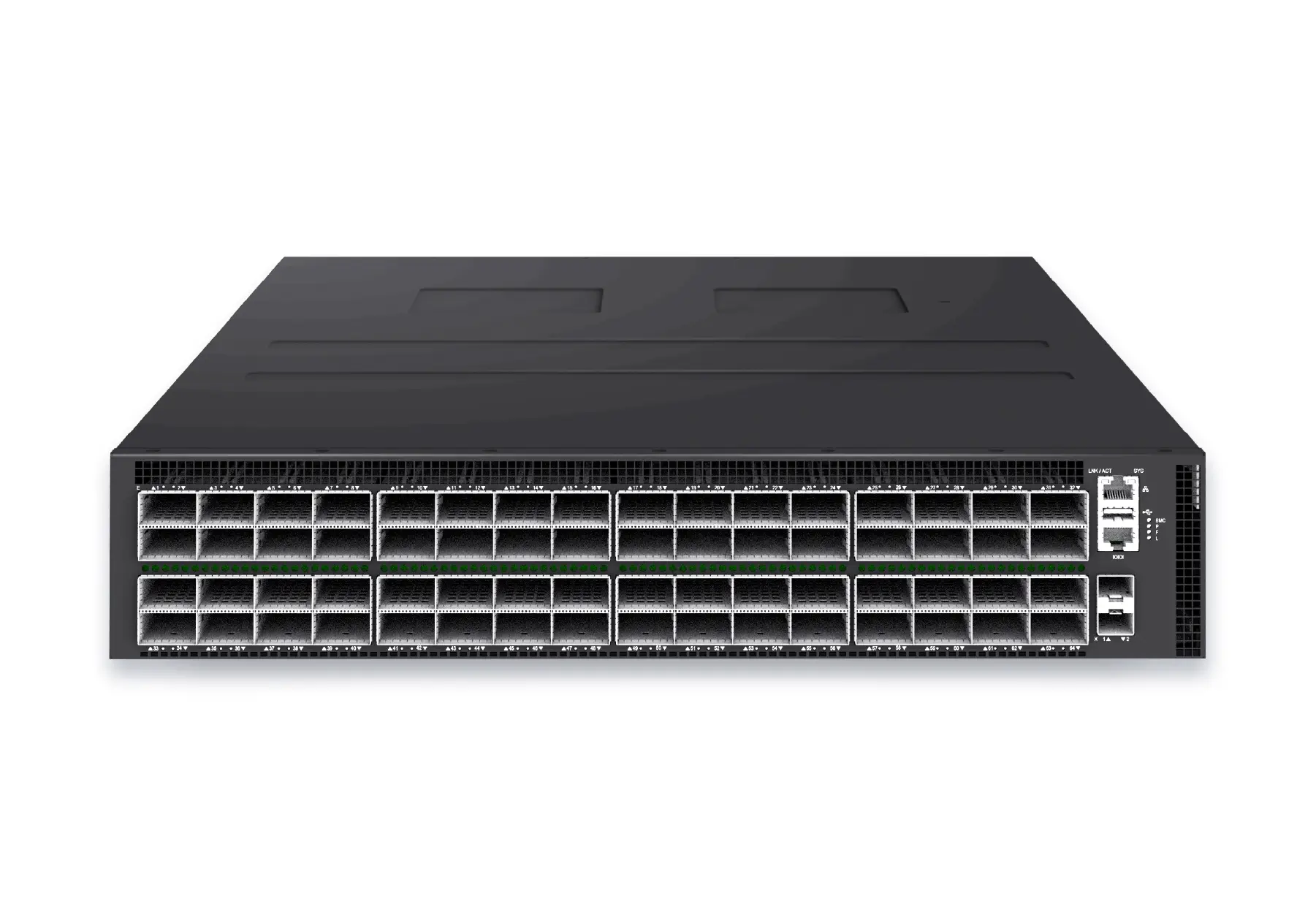 datacenter aiXS-DC-64X800-AI-G164-port 800G AI fabric switch for large-scale GPU clusters, HPC backbones, and ultra-high-throughput data center networks.View product
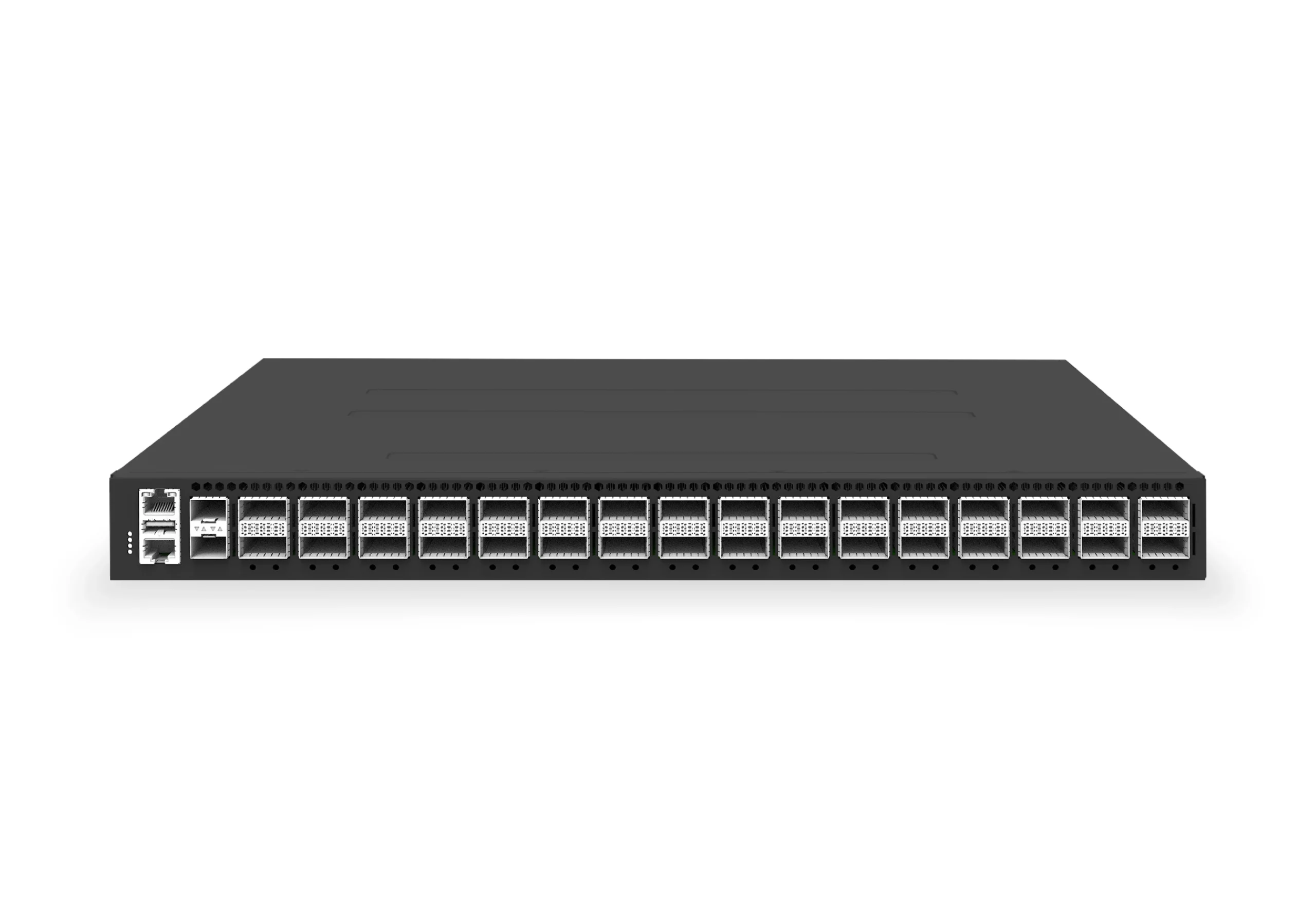 datacenter aiXS-DC-32X400-SP-G232-port 400G spine/core switch for high-capacity data center fabrics and AI-ready backbones.View product
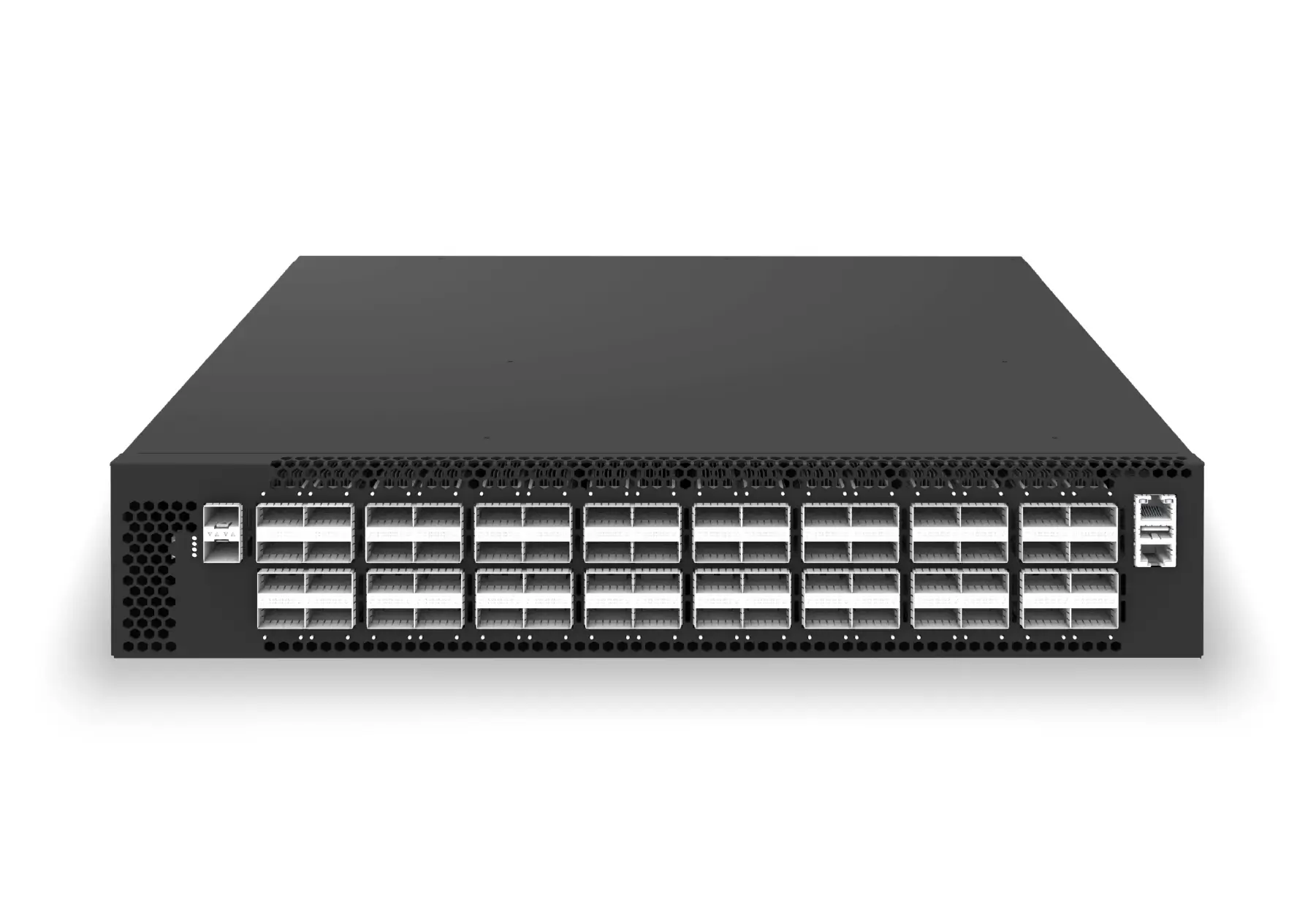 datacenter aiXS-DC-64X200-LS-G164-port 200G leaf/spine switch for high-bandwidth storage, compute, and scale-out data center fabrics.View product
Continue reading
Related articles
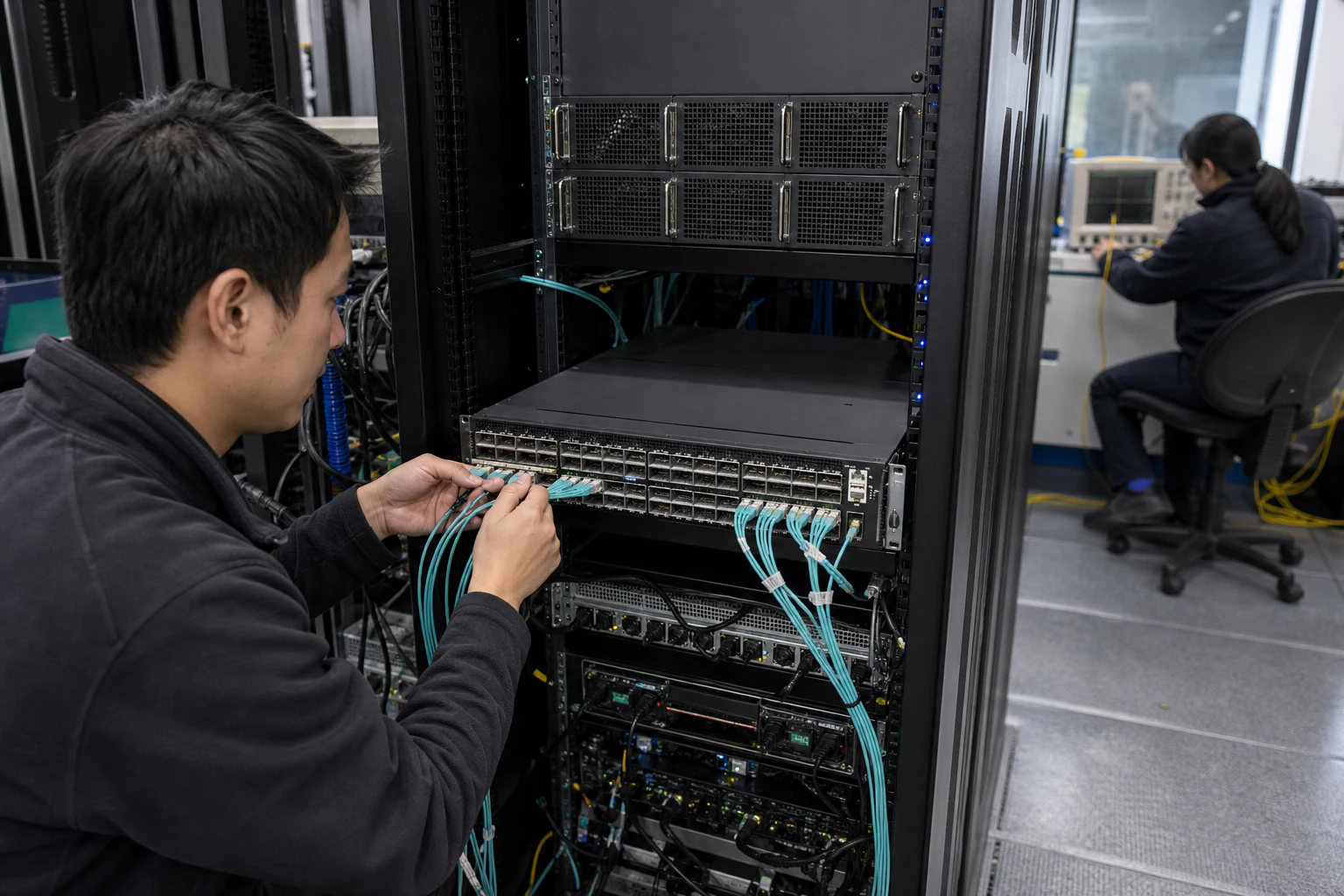 Technical ArticleDCBX, PFC, ECN, and Fast CNP: Building Lossless Ethernet for AI Training FabricsEngineering guidance on DCBX, PFC, ECN, and Fast CNP for Australian AI fabric teams building lossless Ethernet for RoCE v2 training clusters.Read article
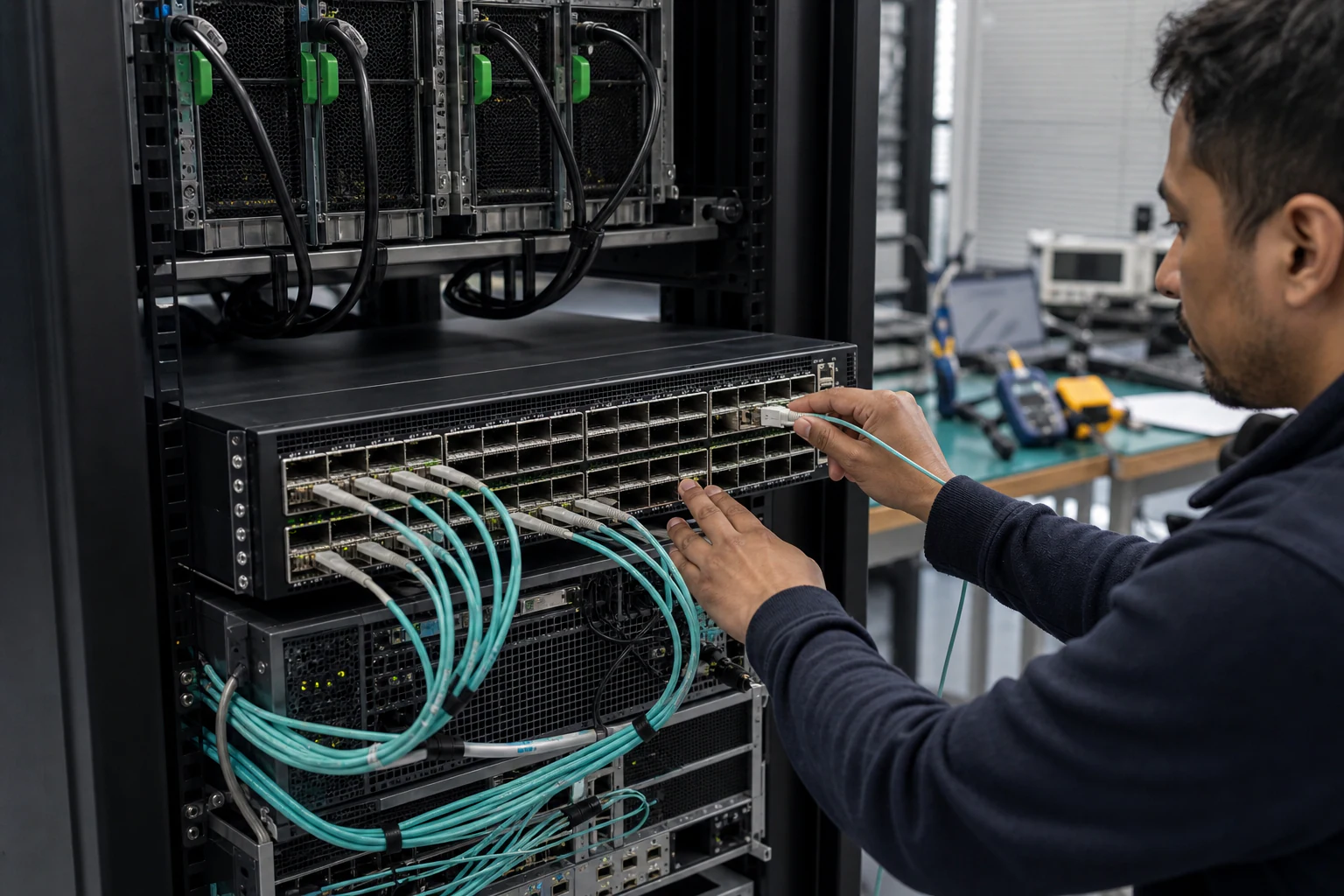 Technical ArticleWhat AI Data Center Ethernet Demands Mean for SONiC Network Operators in AustraliaEngineering guide for Australian SONiC operators running AI Ethernet fabrics, covering RoCE, 400G/800G links, telemetry, failures, optics, and support.Read article
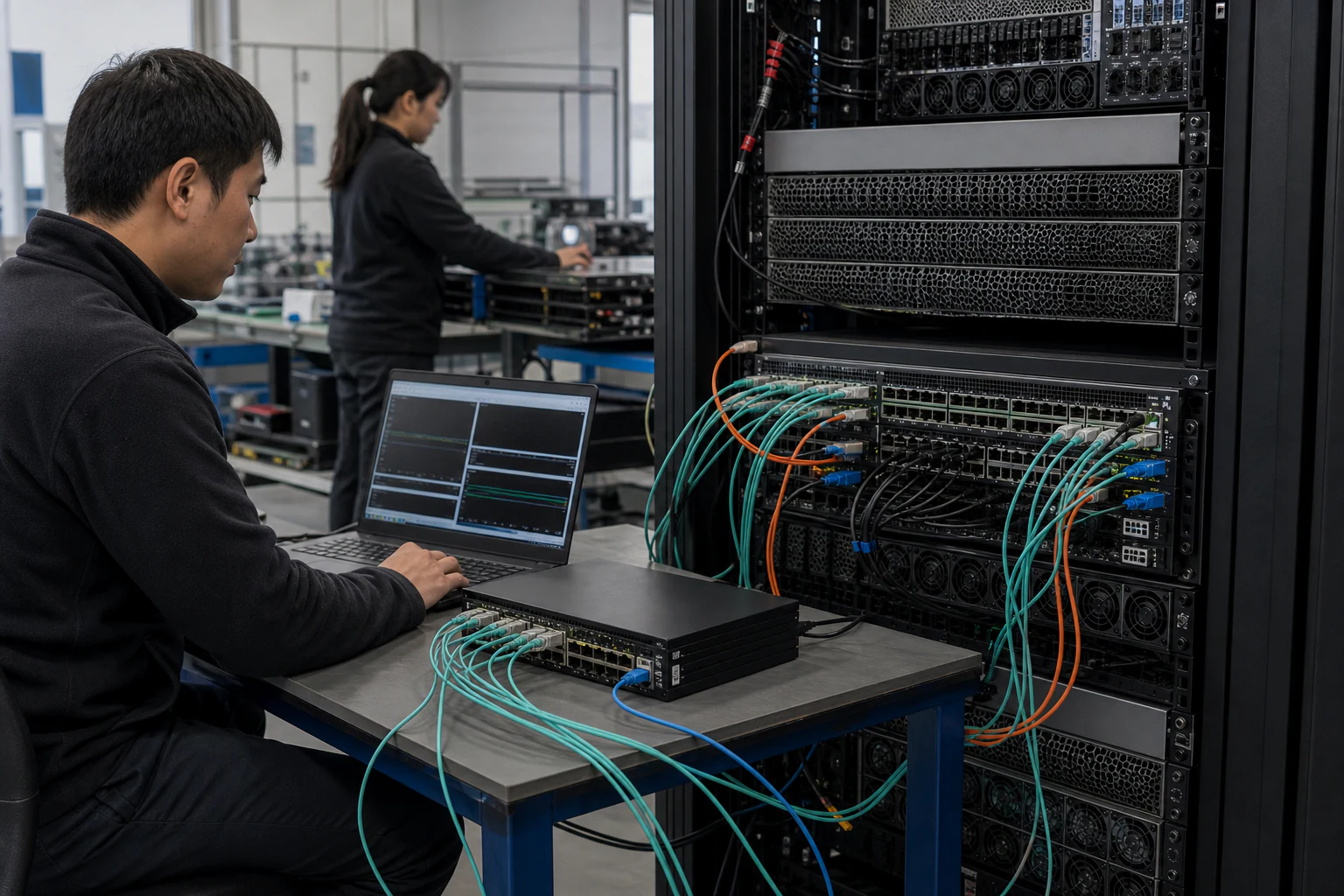 Technical ArticleWhat AI Fabric Ethernet Switching Actually Requires -- and Where SONiC Fits in the StackA practical engineering guide to AI fabric Ethernet switching requirements, explaining where SONiC fits across RoCE v2, PFC, ECN, DCBX, telemetry, and 400G/800G operations.Read article