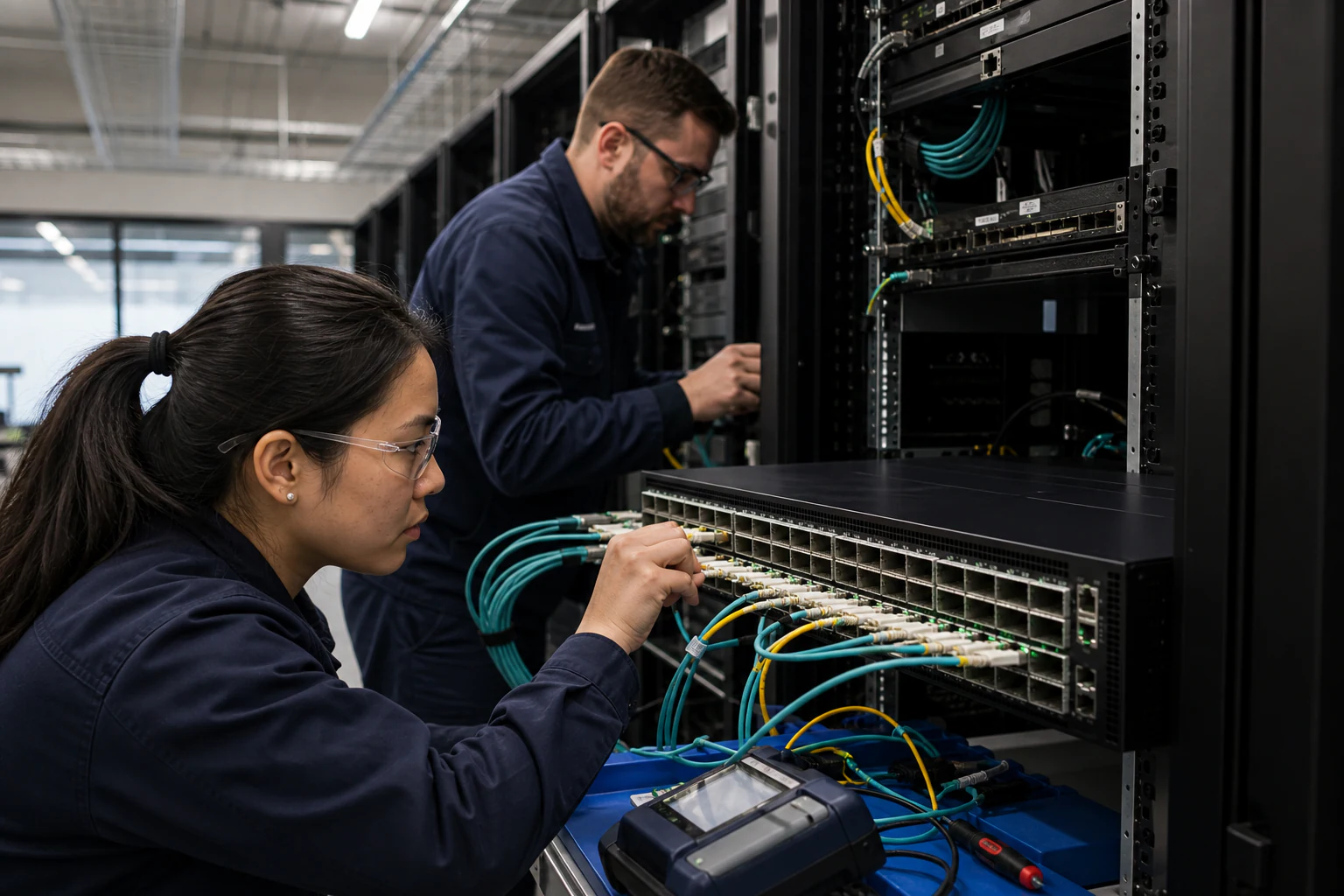
In brief
A practical guide to building high-performance GPU backend fabrics using SONiC open networking and RoCE v2 for AI training and inference workloads in Australian data centers.
Key takeaways
- Traditional data center networks were designed for north-south traffic patterns: web requests flowing from users to servers and back.
- This traffic pattern demands three things that conventional Ethernet struggles to deliver: ultra-low latency, lossless packet delivery, and predictable congestion behavior.
- For Australian organizations building private AI infrastructure -- whether for data sovereignty, latency to local users, or cost control -- the network fabric behind the GPU cluster is now a critical architectural decision.
Why AI Clusters Need a Different Kind of Network
Traditional data center networks were designed for north-south traffic patterns: web requests flowing from users to servers and back. AI training clusters break that model entirely. When hundreds or thousands of GPUs train a large language model, they generate massive east-west traffic flows as parameters, gradients, and activations shuttle between GPUs across the fabric.
This traffic pattern demands three things that conventional Ethernet struggles to deliver: ultra-low latency, lossless packet delivery, and predictable congestion behavior. A single packet drop during an all-reduce operation can stall an entire training job, wasting expensive GPU compute cycles.
For Australian organizations building private AI infrastructure — whether for data sovereignty, latency to local users, or cost control — the network fabric behind the GPU cluster is now a critical architectural decision. Get it wrong, and your multi-million-dollar GPU investment sits partially idle.
This is where SONiC (Software for Open Networking in the Cloud) and RoCE v2 (RDMA over Converged Ethernet v2) come together as a proven, open foundation for AI fabric networking.
What is SONiC and Why Does It Matter for AI?
SONiC is a free, open-source network operating system (NOS) built on Linux. Originally developed by Microsoft for its Azure data centers, it now runs the network infrastructure for some of the world’s largest cloud service providers. The SONiC Foundation, a Linux Foundation project, governs its ongoing development with contributions from major networking and cloud vendors.
SONiC’s architecture is fundamentally different from proprietary switch operating systems. Each network function — BGP, LLDP, DHCP relay, and more — runs in its own Docker container on top of a shared Redis database. This modular, containerized design provides several advantages for AI fabric operations:
- Fault isolation: A crash in one service does not bring down the entire switch.
- Independent upgrades: Teams can update individual components without full switch reboots.
- Multi-vendor hardware support: SONiC runs on switches from multiple vendors through the Switch Abstraction Interface (SAI), which decouples the NOS from the underlying ASIC.
- Programmability: Standard Linux tooling, NETCONF/YANG models, and gNMI telemetry are built in.
For AI fabric use cases, SONiC supports the full suite of protocols needed: BGP for underlay routing, VXLAN for overlay encapsulation, and critically, RDMA for zero-copy, kernel-bypass data transfer between GPU servers.
The practical implication for Australian data center teams is this: you are not locked into a single switch vendor’s proprietary NOS. You can evaluate hardware based on port density, power efficiency, and ASIC capability, then run the same SONiC image across your fleet. This multi-vendor flexibility is a significant advantage when building AI clusters where supply chain diversity matters.
RoCE v2: The Protocol That Makes GPU Clusters Work
RDMA (Remote Direct Memory Access) allows one server to read or write memory on another server without involving the operating system on either end. This kernel-bypass approach dramatically reduces latency and CPU overhead compared to traditional TCP/IP networking.
RoCE v2 runs RDMA over standard UDP/Ethernet networks, which means it can operate on the same physical infrastructure as your regular data center traffic. However, RoCE v2 is sensitive to packet loss in ways that TCP is not. TCP recovers from dropped packets through retransmission. RDMA does not have this graceful recovery mechanism — a dropped packet can cause the entire RDMA operation to fail.
This is why AI fabric networks using RoCE v2 require a set of congestion management features:
- Priority Flow Control (PFC): Pauses traffic at the link level to prevent buffer overflows.
- Data Center Bridging Capability Exchange (DCBX): Negotiates QoS parameters between switches and servers.
- Explicit Congestion Notification (ECN): Marks packets when congestion is building, so the sender can slow down before drops occur.
- Congestion Notification (CNP): The receiver sends congestion notifications back to the sender for rapid rate adjustment.
Together, these mechanisms create a lossless or near-lossless Ethernet fabric that RDMA traffic requires. SONiC supports all of these features, and they are configurable through standard SONiC configuration files and CLI commands.
For Australian teams deploying GPU clusters for model training or inference, understanding RoCE v2 and its prerequisites is not optional. It is the difference between a fabric that works at line rate and one that silently degrades under load.
AI Fabric Architecture: Spine-Leaf with SONiC
The standard topology for AI fabric networks is a leaf-spine (Clos) architecture. Every leaf switch connects to every spine switch, creating a predictable, non-blocking fabric with consistent hop counts between any two endpoints.
In a GPU backend fabric specifically:
- Leaf switches sit at the top of each rack, connecting to GPU servers via 100GbE or 200GbE links.
- Spine switches interconnect the leaf layer, typically at 400GbE or 800GbE.
- The underlay routing protocol is eBGP, which SONiC supports natively.
- For multi-tenant or workload isolation, EVPN-VXLAN overlays segment traffic without sacrificing fabric performance.
Modern switch ASICs purpose-built for AI workloads — such as those powering 100G, 400G, and 800G switch platforms — provide the buffer depth, port density, and forwarding capacity needed for large-scale GPU clusters. SONiC runs on these platforms through the SAI abstraction layer, giving operators a consistent operational model regardless of which ASIC sits under the hood.
For Australian data center operators, this architecture scales linearly. Start with a small cluster for model fine-tuning or inference, then add leaf and spine capacity as GPU counts grow. SONiC’s configuration management makes this expansion operationally straightforward.
Observability and Telemetry: Seeing Inside the AI Fabric
Operating an AI fabric blind is a recipe for mysterious training slowdowns. Traditional SNMP polling with five-minute intervals is far too slow to catch microbursts and transient congestion events that degrade RDMA performance.
SONiC supports modern telemetry approaches that address this gap:
- In-band Network Telemetry (INT): Embeds metadata directly into packets as they traverse each switch hop, giving operators per-hop latency, queue depth, and congestion visibility in real time.
- gNMI Streaming Telemetry: Pushes structured, model-driven telemetry data to collectors at sub-second intervals, replacing legacy SNMP polling.
- sFlow and Mirror-on-Drop: Captures sampled or dropped traffic for forensic analysis.
For AI fabric operators, INT telemetry is particularly valuable. It lets you identify exactly which switch port, which queue, and which moment in time a congestion event occurred — critical data for tuning PFC thresholds, ECN marking points, and buffer allocations.
These telemetry capabilities, combined with SONiC’s open APIs, allow integration with existing Australian enterprise monitoring stacks (Prometheus, Grafana, Elastic, or commercial AIOps platforms) without proprietary lock-in.
Why Open Networking Matters for Australian AI Infrastructure
Australia’s data center market is growing rapidly, driven by cloud adoption, data sovereignty requirements, and now AI workload demand. Several factors make open networking with SONiC particularly relevant for Australian buyers:
Supply chain resilience: Running a multi-vendor SONiC fleet means you are not dependent on a single vendor’s supply chain or pricing decisions. If one switch vendor has lead time issues, you can source equivalent hardware from another SONiC-compatible vendor.
Operational consistency: SONiC provides the same NOS across your entire fabric. Your team learns one operating model, one configuration format, one telemetry pipeline — regardless of which ASIC or switch platform sits underneath.
Cost transparency: Open-source NOS licensing removes hidden software subscription costs from your networking budget. You invest in hardware and support, not perpetual NOS licenses.
Talent availability: SONiC is Linux-based and uses standard networking protocols. Engineers with Linux and BGP experience can transition to SONiC operations with manageable training investment.
AI workload agility: As AI model architectures evolve, your network requirements will change. An open, programmable NOS lets you adapt configurations, telemetry targets, and QoS policies without waiting for a vendor’s next software release.
These advantages compound over time as your AI infrastructure grows from a proof-of-concept cluster to a production platform serving multiple teams and workloads.
Getting Started: A Practical Checklist for Australian Teams
If you are evaluating SONiC-based AI fabric networking for your Australian data center, here is a practical starting framework:
-
Define your GPU cluster scale: How many GPUs, what server form factor, what NIC speed (100G, 200G, 400G)? This determines your leaf switch port density and spine uplink bandwidth.
-
Select SONiC-compatible switch hardware: Evaluate platforms based on ASIC capability, port count, buffer depth, and power consumption. Verify SONiC compatibility through the SONiC Foundation’s supported devices list.
-
Design the fabric topology: Leaf-spine with eBGP underlay is the standard starting point. Plan for non-blocking fabric at your target GPU-to-GPU bandwidth.
-
Configure RoCE v2 prerequisites: Enable PFC, DCBX, ECN, and CNP on all fabric switches and server NICs. Validate lossless behavior with synthetic RDMA traffic before loading production workloads.
-
Deploy telemetry: Enable INT and gNMI streaming telemetry from day one. You will need this data for capacity planning and troubleshooting.
-
Document and automate: SONiC’s JSON configuration and Linux tooling make it well-suited to Infrastructure-as-Code workflows. Automate fabric provisioning and configuration validation early.
GPU Backend Fabric Acceptance Matrix
| Fabric layer | Evidence to collect | Minimum acceptance target | Rework trigger |
|---|---|---|---|
| Physical links | NIC speed, switch port speed, optics SKU, DOM telemetry, and cable length | 100G/200G server links and 400G/800G spine links validated as designed | Link speed is accepted from a BOM without DOM evidence |
| RoCE policy | PFC priority, ECN thresholds, DCBX negotiation, CNP counters, and queue maps | 30-minute RDMA run with 0 unexplained RDMA priority drops | PFC pauses propagate across non-RDMA queues |
| Underlay | eBGP sessions, ECMP next hops, MTU, BFD or timers, and convergence logs | 1 leaf failure and 1 spine failure tested with recorded recovery time | Fabric works only in steady state |
| Telemetry | INT/IPTPath, gNMI, queue depth, buffer occupancy, and per-port error counters | Congestion root cause isolated to switch, port, queue, and path within 15 minutes | Operators see job slowdown but not network cause |
| Operations | Config backup, image upgrade, rollback, support owner, and runbook | 1 upgrade and 1 rollback completed before production GPU jobs | Routine recovery requires vendor-only access |
The Bottom Line
AI infrastructure is a capital-intensive investment, and the network fabric is the connective tissue that determines whether your GPUs work at full capacity or sit waiting on the network. SONiC, combined with RoCE v2 and modern congestion management protocols, provides a proven, open, and operationally consistent foundation for GPU backend fabrics.
For Australian data center teams, the open networking path offers tangible advantages: multi-vendor hardware flexibility, transparent costs, Linux-native operations, and the ability to adapt as AI workloads evolve. The technology is production-proven at hyperscale. The question for enterprise and mid-market buyers is not whether it works, but how to operationalize it for their specific scale and requirements.
xSONiC’s data center AI switches are designed to run SONiC and deliver the port speeds, buffer depth, and feature set that AI fabric workloads demand. Combined with matched optical transceivers and the AIDC Controller for fabric management, xSONiC provides a vertically integrated open networking stack for AI infrastructure.
Engineering FAQ
What should be proven before putting GPU jobs on a SONiC/RoCE fabric? Prove RoCE v2 connectivity, PFC/ECN behaviour, RDMA throughput, p99 latency, ECMP balance, failure recovery, telemetry, optics health, and rollback on the exact hardware and NOS image.
Why is packet loss more damaging for GPU backend traffic? RoCE-based GPU communication is sensitive to drops and congestion. A single bad queue policy or ECMP imbalance can stall collective operations and waste expensive GPU time.
How should Australian teams start safely? Start with a bounded pod: 2 leaf switches, 1 spine, at least 2 GPU nodes, production-like optics, and a 30-minute RDMA plus failure test before scaling to the full fabric.
Related xSONiC Resources
Sources Reviewed
- Ethernet Network Adapters - ConnectX NICs | NVIDIA
- NVIDIA BlueField Data Processing Unit
- NVIDIA Spectrum-X Ethernet Platform
- OpenConfig gNMI Specification
- OpenConfig
- RFC 7950 - The YANG 1.1 Data Modeling Language
- RFC 6241 - Network Configuration Protocol (NETCONF)
- SONiC Project Documentation
- Broadcom Ethernet Switching
- Marvell Switching
- NVIDIA Ethernet Switching
- Open Compute Networking
- SONiC GitHub
- SONiC Foundation
Product fit
Products referenced for evaluation
These products are referenced for evaluation context in the article. Confirm workload, port, optics, software, interoperability, and support requirements against the exact deployment before procurement.
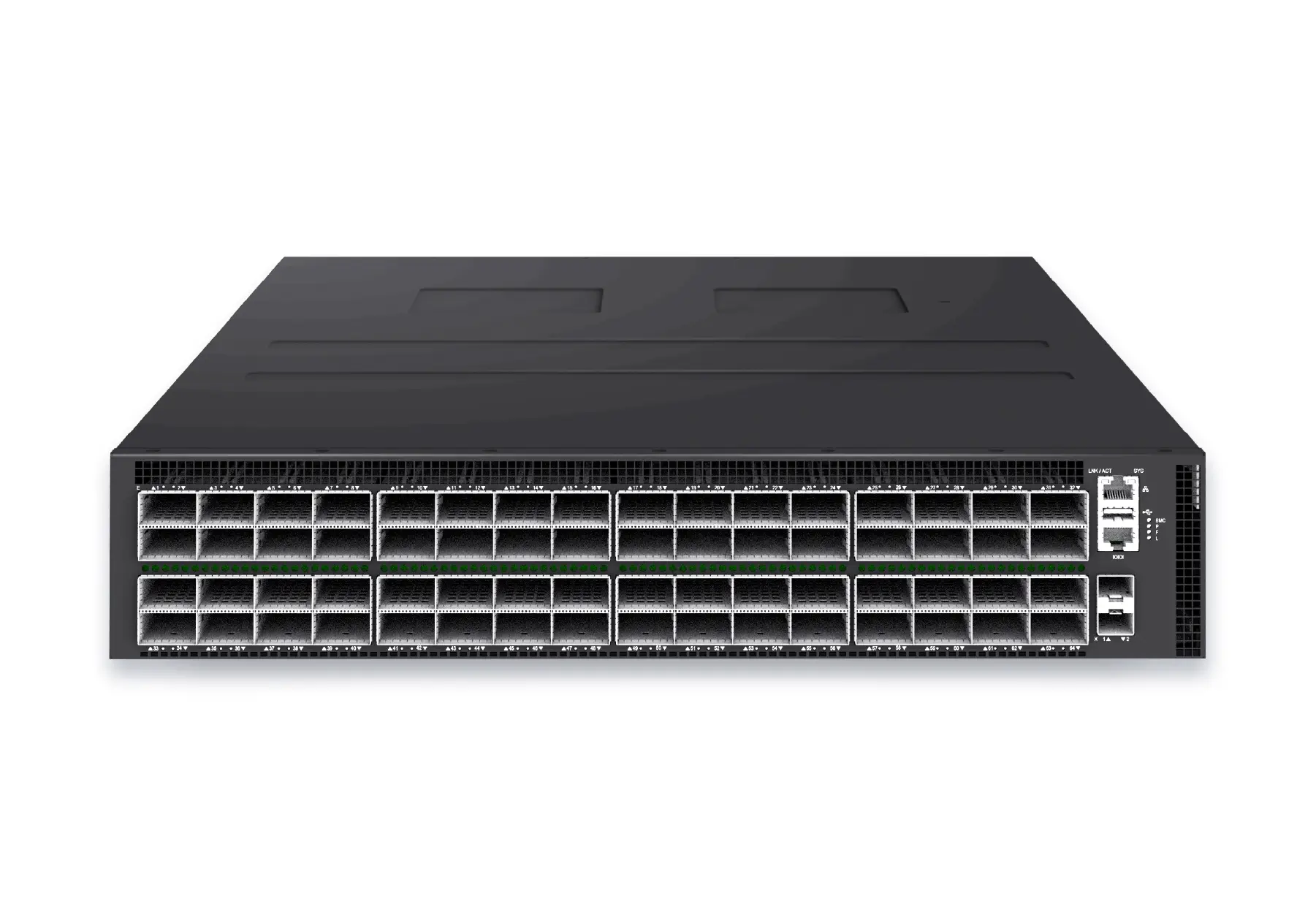 datacenter aiXS-DC-64X800-AI-G164-port 800G AI fabric switch for large-scale GPU clusters, HPC backbones, and ultra-high-throughput data center networks.View product
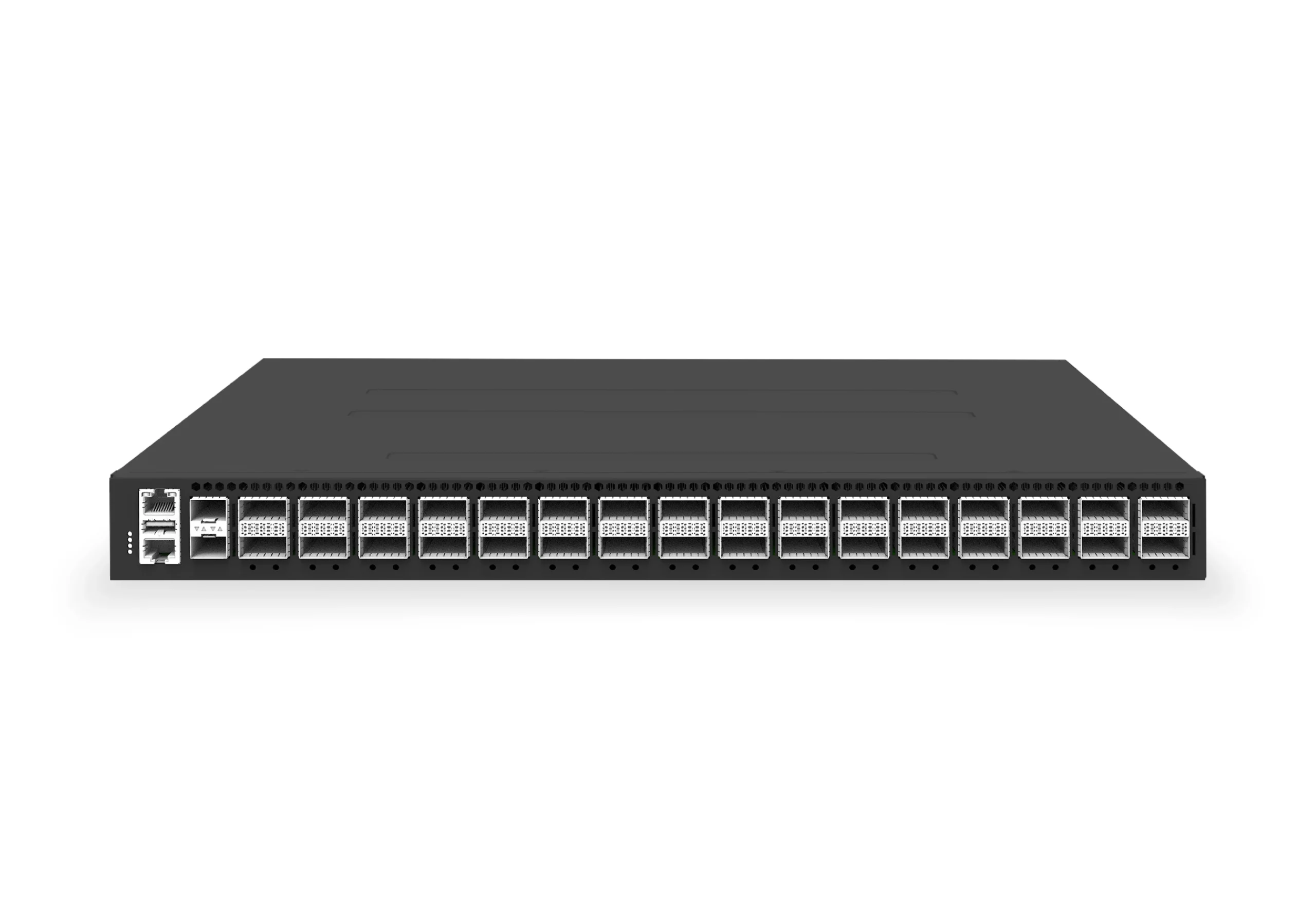 datacenter aiXS-DC-32X400-SP-G232-port 400G spine/core switch for high-capacity data center fabrics and AI-ready backbones.View product
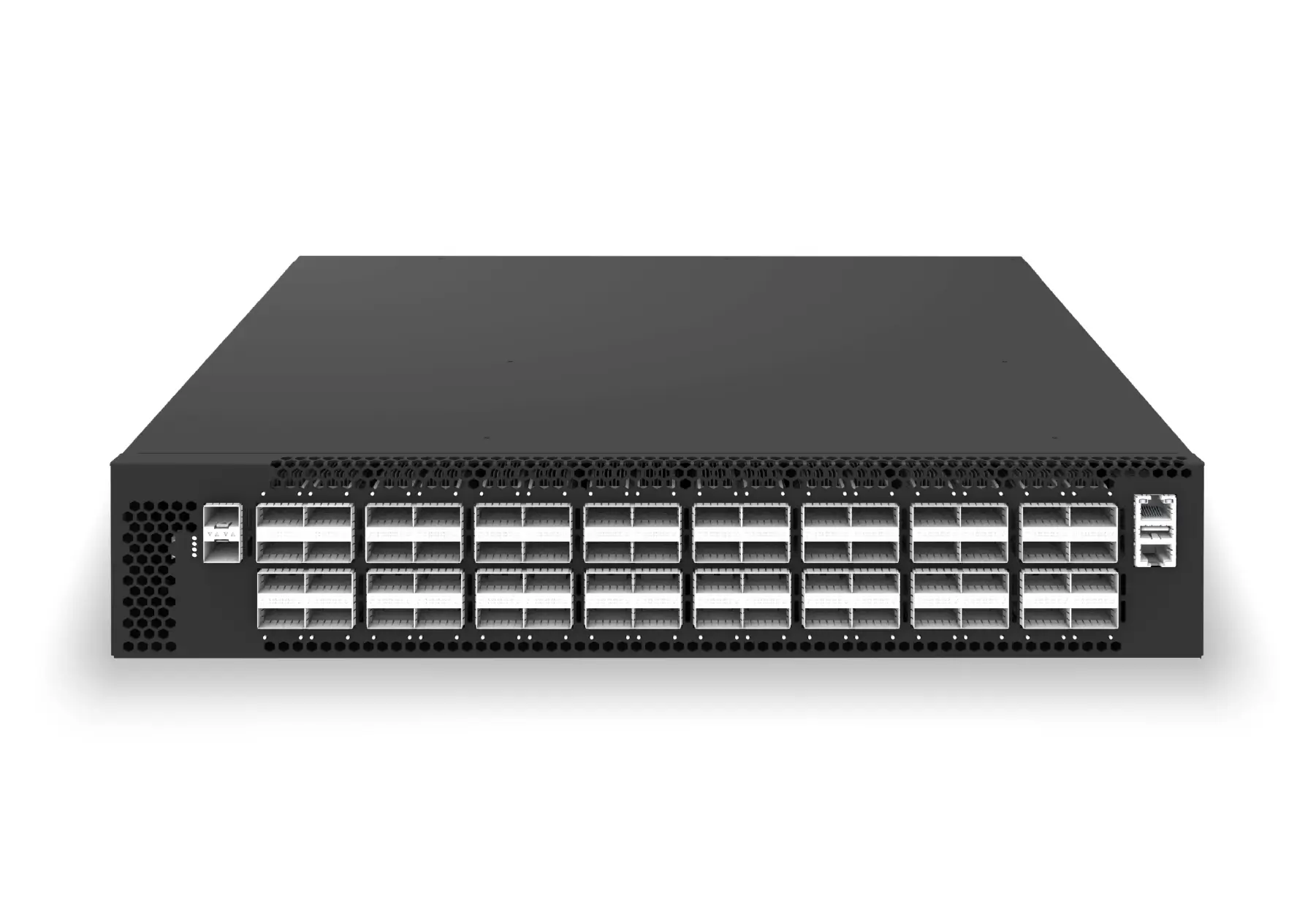 datacenter aiXS-DC-64X200-LS-G164-port 200G leaf/spine switch for high-bandwidth storage, compute, and scale-out data center fabrics.View product
Continue reading
Related articles
 Technical ArticleDCBX, PFC, ECN, and Fast CNP: Building Lossless Ethernet for AI Training FabricsEngineering guidance on DCBX, PFC, ECN, and Fast CNP for Australian AI fabric teams building lossless Ethernet for RoCE v2 training clusters.Read article
 Technical ArticleWhat AI Data Center Ethernet Demands Mean for SONiC Network Operators in AustraliaEngineering guide for Australian SONiC operators running AI Ethernet fabrics, covering RoCE, 400G/800G links, telemetry, failures, optics, and support.Read article
 Technical ArticleWhat AI Fabric Ethernet Switching Actually Requires -- and Where SONiC Fits in the StackA practical engineering guide to AI fabric Ethernet switching requirements, explaining where SONiC fits across RoCE v2, PFC, ECN, DCBX, telemetry, and 400G/800G operations.Read article