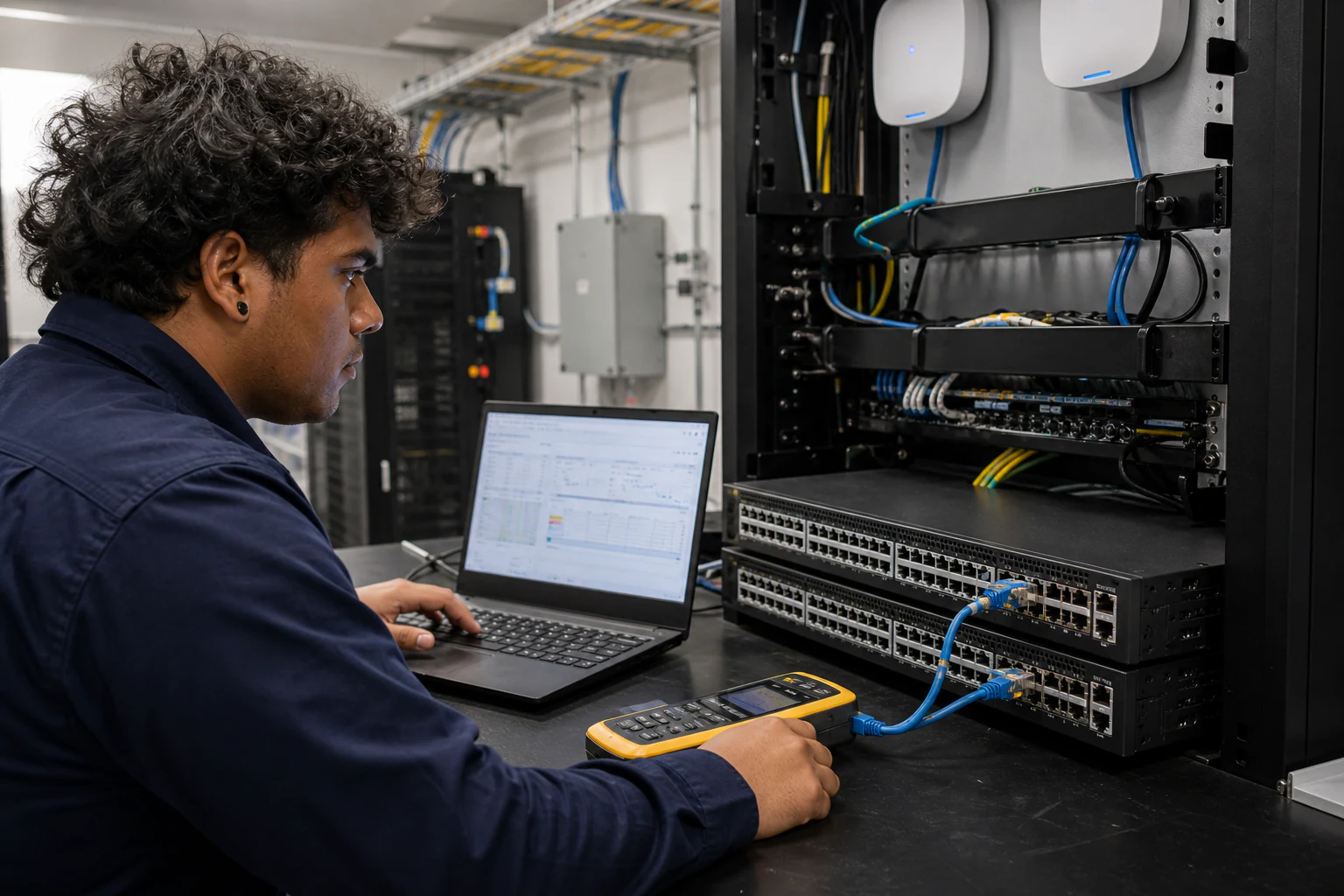
In brief
Engineering guidance for Australian Wi-Fi 7 and OpenWiFi planning, covering 6 GHz spectrum, MLO, 320 MHz channels, PoE++, multi-gig backhaul, and controller support.
Key takeaways
- Wi-Fi 7 (IEEE 802.11be) is not just a speed bump. The standard introduces Multi-Link Operation (MLO), 320 MHz-wide channels in the 6 GHz band, 4096-QAM modulation, and deterministic latency features that let access points transmit across multiple bands simultaneously.
- At the same time, the OpenWiFi initiative is maturing. Originally incubated by the Telecom Infra Project (TIP) and now extending into SONiC-based wireless, OpenWiFi disaggregates the traditional controller-AP relationship.
- TIP describes OpenWiFi as a community-developed, disaggregated Wi-Fi software system with both controller SDK and enterprise AP firmware.
Why Wi-Fi 7 and OpenWiFi belong in the same planning conversation
Wi-Fi 7 (IEEE 802.11be) is not just a speed bump. The standard introduces Multi-Link Operation (MLO), 320 MHz-wide channels in the 6 GHz band, 4096-QAM modulation, and deterministic latency features that let access points transmit across multiple bands simultaneously. For enterprise buyers evaluating a campus refresh, the technology shift is significant enough to warrant rethinking the entire access layer architecture, not just swapping radios.
At the same time, the OpenWiFi initiative is maturing. Originally incubated by the Telecom Infra Project (TIP) and now extending into SONiC-based wireless, OpenWiFi disaggregates the traditional controller-AP relationship. Instead of buying a tightly coupled controller-plus-AP bundle from a single vendor, enterprises can deploy open access point hardware managed by a cloud-native or on-premises controller stack that is decoupled from the silicon.
TIP describes OpenWiFi as a community-developed, disaggregated Wi-Fi software system with both controller SDK and enterprise AP firmware. TIP’s OpenWiFi 4.0 announcement also matters for buyers because it introduced Wi-Fi 7 support and reported 3Gbps-plus throughput across compatible AP models from CIG, Edgecore, and Cybertan. That does not automatically prove an Australian campus deployment, but it does move OpenWiFi from an architectural idea into something that can be piloted with real Wi-Fi 7 hardware.
The convergence matters because Wi-Fi 7 hardware is arriving at a moment when the access layer software model is also in flux. Australian enterprise network teams evaluating campus refresh cycles in 2025 and 2026 face a two-axis decision: which Wi-Fi generation to deploy and which management architecture to adopt.
What Wi-Fi 7 actually changes for enterprise wireless
Wi-Fi 7’s headline features are defined by IEEE 802.11be and surfaced to buyers through the Wi-Fi Alliance certification program.
The features that matter most for enterprise campus planning include:
- Multi-Link Operation (MLO): An AP and a client can simultaneously send and receive on multiple frequency bands (2.4 GHz, 5 GHz, 6 GHz). This reduces latency and improves reliability, which benefits real-time applications like voice and industrial IoT.
- 320 MHz channels in 6 GHz: Doubling the maximum channel width from Wi-Fi 6E’s 160 MHz pushes peak theoretical throughput significantly higher. However, 320 MHz channels consume a large portion of the available 6 GHz spectrum, making channel planning in dense enterprise environments more complex.
- 4096-QAM: Higher-order modulation increases spectral efficiency at short range, useful for high-density conference rooms and collaboration spaces.
- Preamble puncturing and improved interference management: Allows the AP to use portions of a wide channel even when adjacent channels are occupied, which is practical in multi-tenant buildings.
For Australian buyers, a critical planning variable is 6 GHz spectrum allocation. The Australian Communications and Media Authority (ACMA) has been evaluating the upper 6 GHz band (6425-7125 MHz) for Wi-Fi use.
What OpenWiFi changes about the controller model
SONiC, the open-source network operating system backed by the SONiC Foundation under the Linux Foundation, is well established in data center switching.
Source evidence: The SONiC Foundation site (sonicfoundation.dev) describes SONiC as “an open source network operating system (NOS) based on Linux that runs on switches from multiple vendors and ASICs” offering “a full suite of network functionality” that “decouples hardware and software” through a container-based architecture (sonicfoundation.dev). The GitHub repository (github.com/sonic-net/SONiC) confirms SONiC uses “modular architecture where each network function runs in its own Docker container” providing “better fault isolation” and “simplified upgrades” (github.com/sonic-net/SONiC).
The OpenWiFi extension of SONiC into wireless applies the same disaggregation principle to the access layer. Instead of requiring a proprietary wireless LAN controller from the AP vendor, OpenWiFi separates the AP hardware (the data plane and radio) from the management and control software.
For enterprise buyers, the practical implications are:
- Vendor choice at the hardware layer: You can select AP hardware from multiple suppliers and manage them through a common controller platform.
- Reduced lock-in risk: Controller licensing and support costs are decoupled from AP hardware refresh cycles.
- Consistency with wired infrastructure: If your campus switches already run SONiC or an enterprise SONiC distribution, extending the same operating philosophy to wireless simplifies operations and skills requirements.
The Australian campus refresh context
Australian enterprise campuses face several planning pressures that make the Wi-Fi 7 plus OpenWiFi combination worth evaluating:
-
End-of-life Wi-Fi 5 and early Wi-Fi 6 APs: Many Australian campuses deployed Wi-Fi 5 (802.11ac) APs in 2016-2018 and are reaching refresh cycles. Wi-Fi 7 APs offer a generational leap, but supply chain lead times for certified hardware need to be confirmed.
-
PoE infrastructure upgrades: Wi-Fi 7 APs with multiple radios and higher processing demands may require PoE++ (802.3bt, up to 90W per port) rather than the PoE+ (802.3at, 30W) infrastructure many campuses have today. This connects directly to campus access switch planning.
-
6 GHz regulatory clarity: As noted above, the full scope of Australian 6 GHz spectrum availability directly affects whether 320 MHz channels and MLO across all three bands are practical in local deployments.
-
Managed service and integration partner ecosystem: OpenWiFi adoption depends on the maturity of integration partners and managed service providers in the Australian market who can deploy and support disaggregated wireless.
Decision framework for Australian enterprise buyers
| Planning dimension | Controller-locked Wi-Fi 7 | OpenWiFi Wi-Fi 7 |
|---|---|---|
| Hardware selection | Single-vendor AP and controller bundle | Multi-vendor AP hardware, common controller |
| Management model | Proprietary cloud or on-prem controller | Cloud-native or on-prem, open-source or commercial controller stack |
| Skills requirement | Vendor-specific training | Linux/SONiC familiarity, open-source troubleshooting |
| Refresh cycle coupling | AP and controller refresh often coupled | AP hardware and controller software refresh decoupled |
| Australian support ecosystem | Mature, established vendor channels | Developing; depends on integration partner availability |
| 6 GHz spectrum dependency | Same ACMA constraints | Same ACMA constraints |
Engineering Acceptance Matrix for Wi-Fi 7 OpenWiFi Pilots
Wi-Fi 7 refreshes fail when teams accept the radio standard but do not accept the installed system. Use a pilot matrix that measures RF, wired access, controller behaviour, and support ownership together.
| Acceptance area | What to test | Passing evidence | Risk if skipped |
|---|---|---|---|
| RF and client readiness | 2.4 GHz, 5 GHz, and 6 GHz plans; MLO behaviour; 320 MHz assumptions; 4096-QAM proximity limits | Pilot confirms roaming, application latency, and client compatibility in one representative floor or building | Headline Wi-Fi 7 rates are quoted, but users still see poor roaming or unstable latency |
| Wired access layer | AP uplink speed, 2.5G/5G/10G port need, PoE draw, switch thermal headroom, 25G/100G aggregation | Switch telemetry proves APs are not bottlenecked by 1G access ports, PoE budget, or oversubscribed uplinks | AP refresh forces an unplanned switch refresh |
| OpenWiFi controller | AP adoption, policy push, log export, config backup, firmware rollback, controller failover | Controller can recover a failed AP, roll back firmware, and export evidence for support | The support boundary between AP vendor, controller owner, and switch vendor is unclear |
| Australian compliance | ACMA 6 GHz operating rules, RF profile, data residency for cloud controller telemetry, 802.1X/RADIUS | Deployment profile is documented for AU channels, security policy, and privacy obligations | Global firmware or offshore telemetry creates compliance and audit issues |
| Operations handover | Help-desk workflow, SSID ownership, certificate renewal, guest access, IoT segmentation | Runbook includes five repeatable checks: AP status, client auth, VLAN policy, RF health, and controller logs | Wireless becomes dependent on one engineer who understands the pilot |
What to watch next
- Wi-Fi Alliance Wi-Fi 7 certification programme: Certification of enterprise-grade APs will signal production readiness.
- ACMA upper 6 GHz decision: The outcome will determine how much spectrum Australian enterprises can use for 320 MHz channels and full MLO.
- SONiC wireless extension releases: Track the maturity of OpenWiFi controller platforms and their compatibility with Wi-Fi 7 AP chipsets.
- Australian enterprise pilots: Early adopter deployments will reveal real-world performance, power, and management experience.
Engineering FAQ
Should Australian campuses skip Wi-Fi 6E and go directly to Wi-Fi 7? Not automatically. The right timing depends on client device mix, 6 GHz channel availability, PoE budget, switch uplinks, cabling, and whether the operations team is ready for MLO troubleshooting.
What is the biggest Wi-Fi 7 design trap? Treating theoretical PHY rate as user experience. Dense campuses are usually constrained by channel planning, AP placement, client capability, roaming, interference, and wired uplink capacity.
Where does OpenWiFi change the buying model? OpenWiFi separates AP hardware from controller and management software. That can reduce lock-in, but buyers must verify firmware provenance, support ownership, controller maturity, and Australian integration capability.
What should be tested before rollout? Test 2.4/5/6 GHz channel plans, MLO behaviour, WPA3/802.1X, roaming, PoE draw, switch uplinks, controller failover, firmware rollback, and guest/corporate segmentation.
Related xSONiC Resources
Sources Reviewed
- IEEE 802.11be Wireless LAN Standard
- IEEE 802.3bt Power over Ethernet
- Wi-Fi 7 Technical Guide - Cisco Meraki Documentation
- ACMA Planning Options for Upper 6 GHz Band
- Telecom Infra Project OpenLAN / OpenWiFi
- TIP OpenWiFi 4.0 Wi-Fi 7 Support
- SONiC Project Documentation
- Open Compute Networking
- SONiC GitHub
- SONiC Foundation
Product fit
Products referenced for evaluation
These products are referenced for evaluation context in the article. Confirm workload, port, optics, software, interoperability, and support requirements against the exact deployment before procurement.
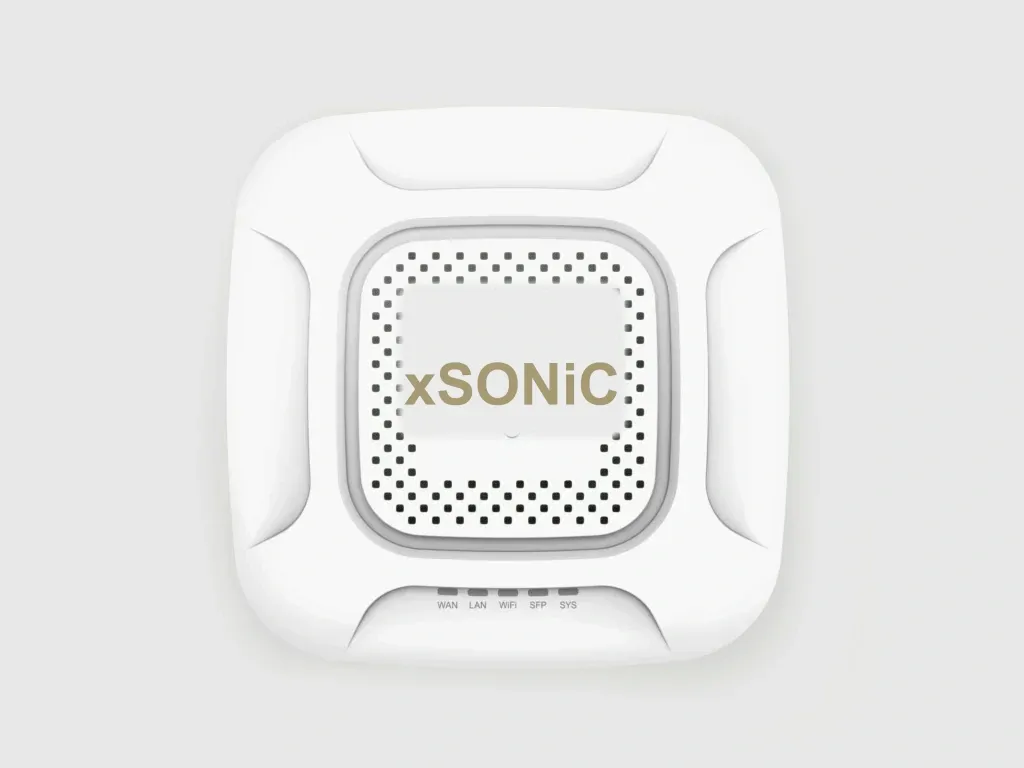 access pointXS-AP-7330Wi-Fi 7 indoor enterprise access point with 9Gbps aggregate wireless capacity and OpenWiFi-aligned operations.View product
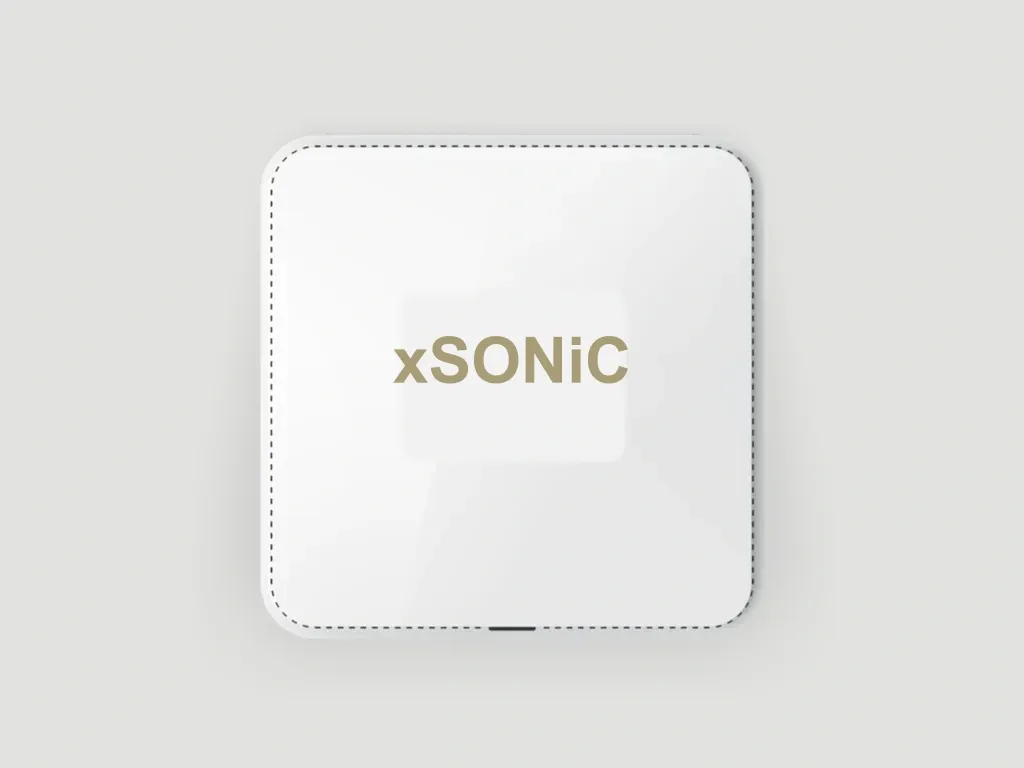 access pointXS-AP-7360Wi-Fi 7 ceiling enterprise access point with 18Gbps aggregate wireless capacity and OpenWiFi-aligned operations.View product
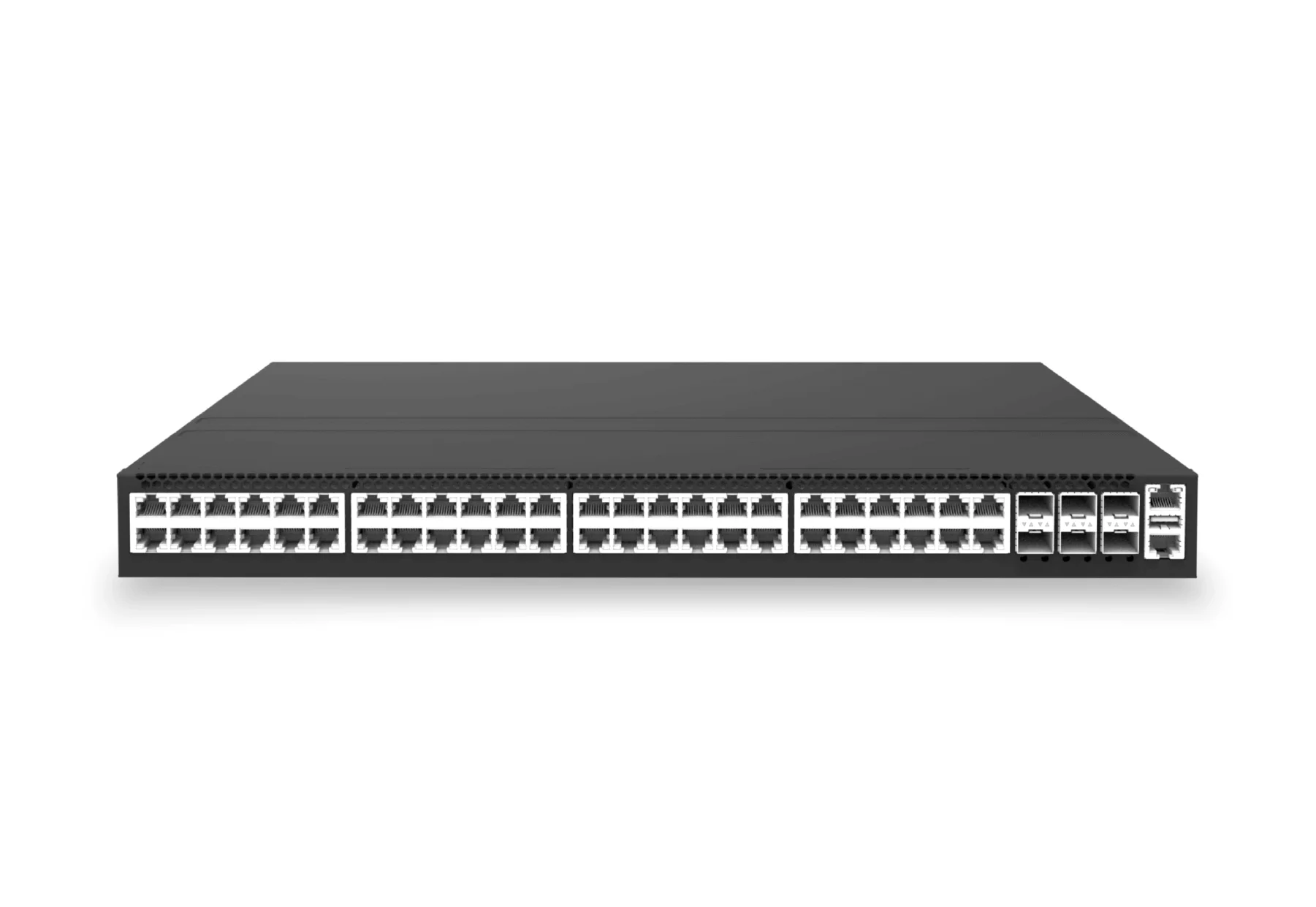 access aggregateXS-AA-48X2P5-6X25-POE144048x 2.5G RJ45 PoE campus access switch with 6x 25G SFP28 for PoE edge, access and aggregation networks.View product
Continue reading
Related articles
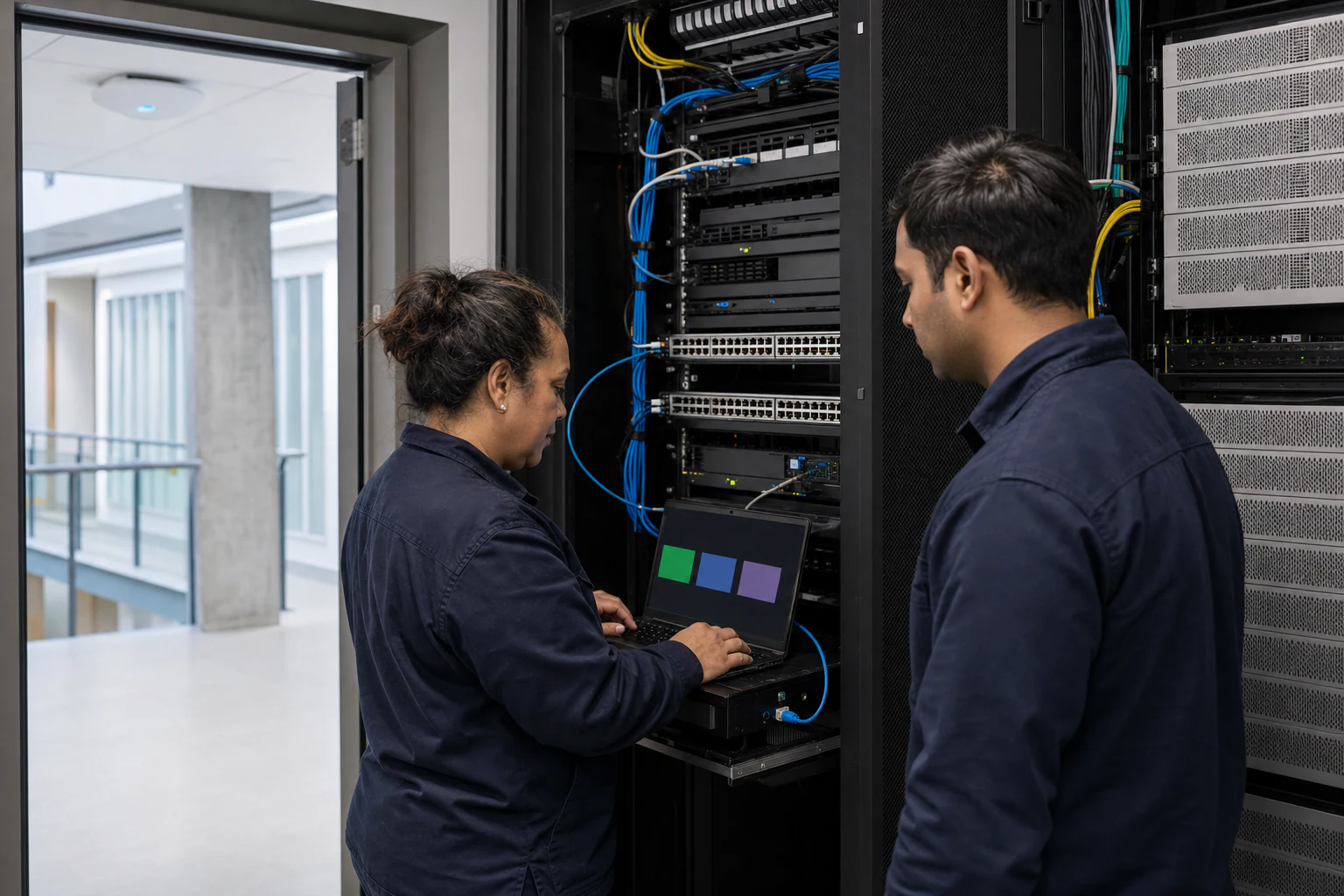 Technical ArticleWi-Fi 7 OpenWiFi Enterprise AP Deployment Planning: What Australian Network Teams Need to KnowWi-Fi 7 OpenWiFi enterprise AP deployment planning for Australian campus teams, covering RF, clients, PoE, backhaul, security, and pilots.Read article
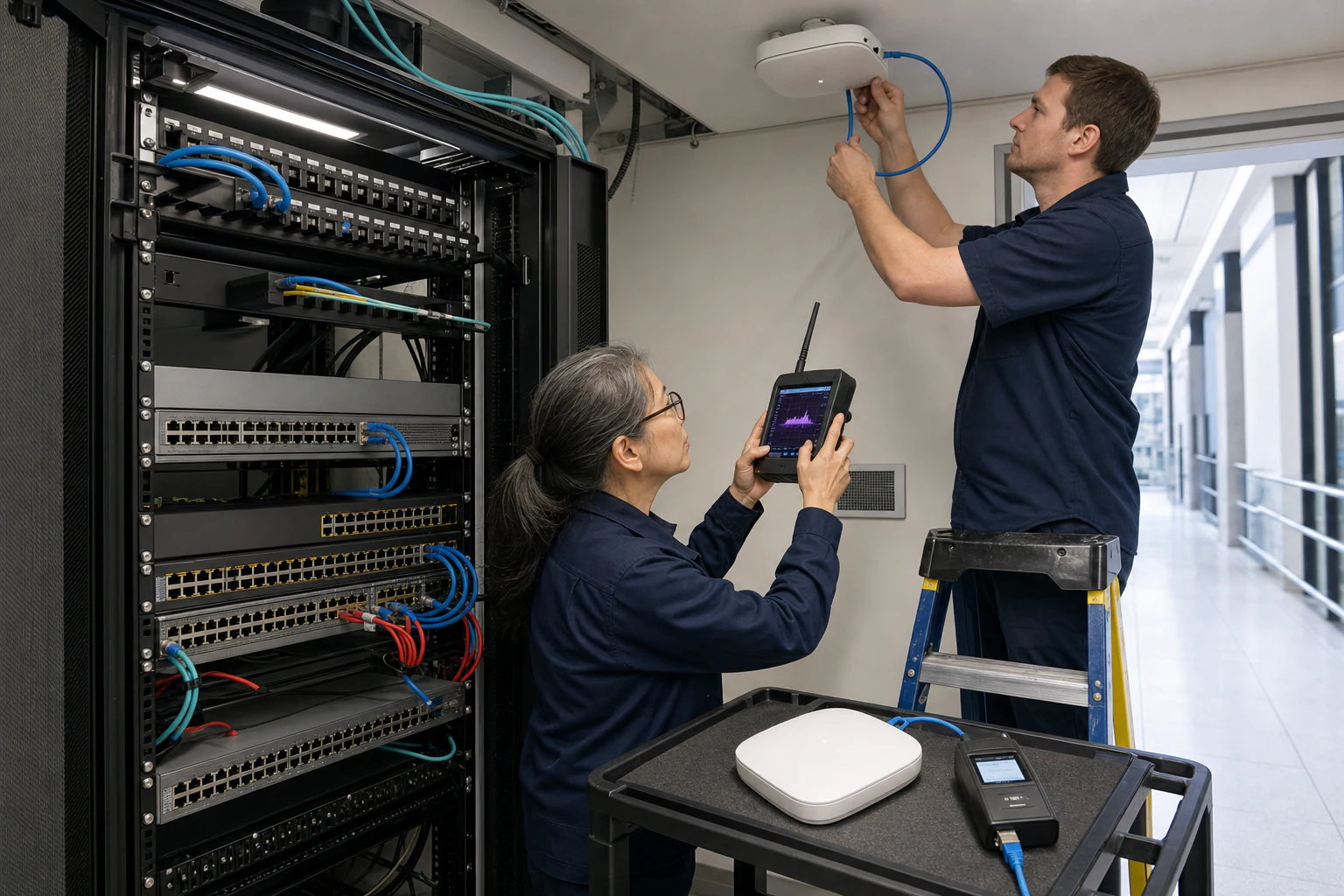 Technical ArticleWi-Fi 7 OpenWiFi Deployment Risk Checklist for Australian IT TeamsWi-Fi 7 OpenWiFi enterprise AP risk-test guide for Australian campus teams, covering RF, security, client readiness, PoE, backhaul, and pilots.Read article
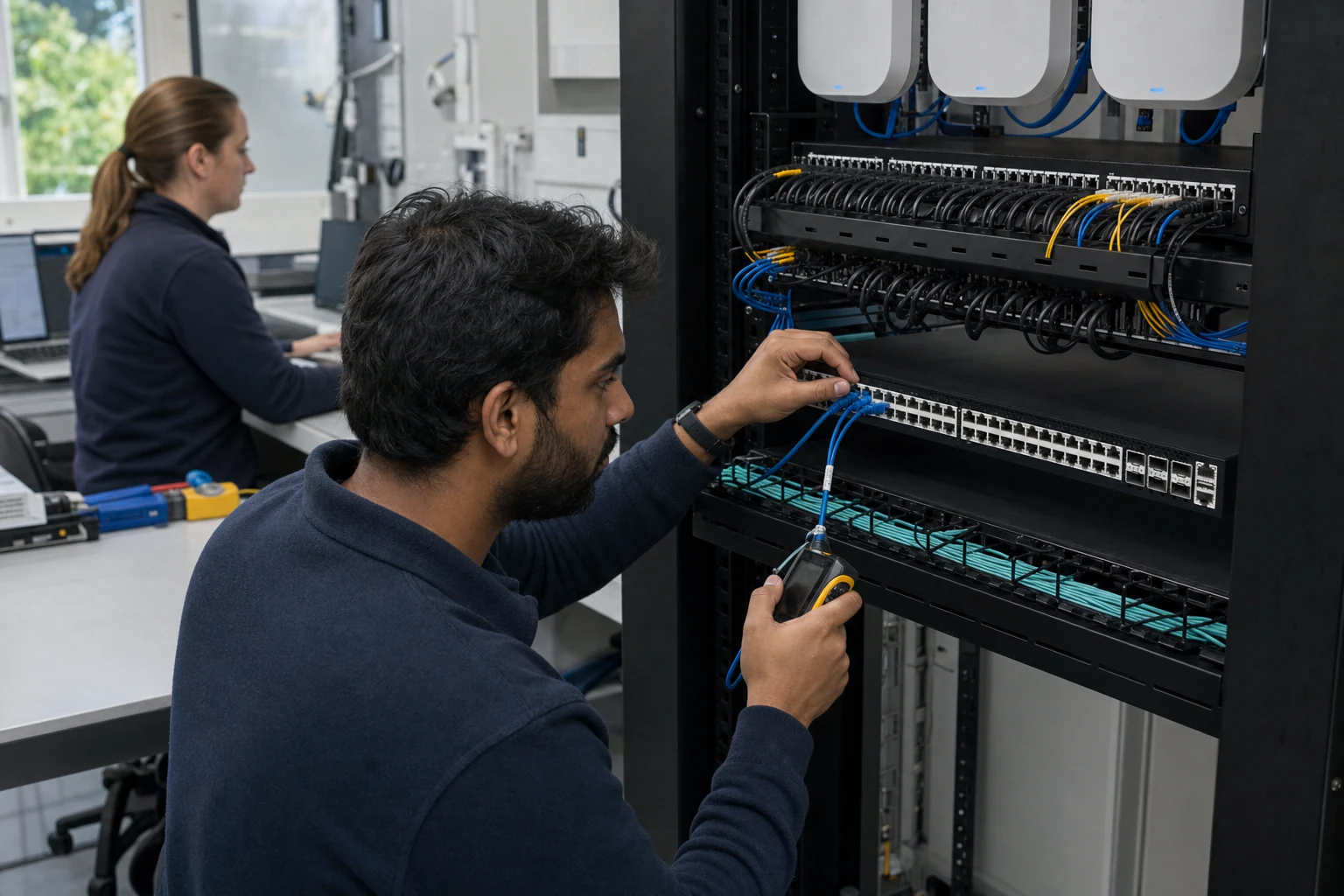 Technical ArticleWi-Fi 6E and Wi-Fi 7 Enterprise Campus Planning in Australia: What Network Buyers Need to Know NowEnterprise Wi-Fi 6E and Wi-Fi 7 campus planning guidance for Australia, covering RF, 6 GHz rules, PoE budgets, uplinks, clients, and pilots.Read article