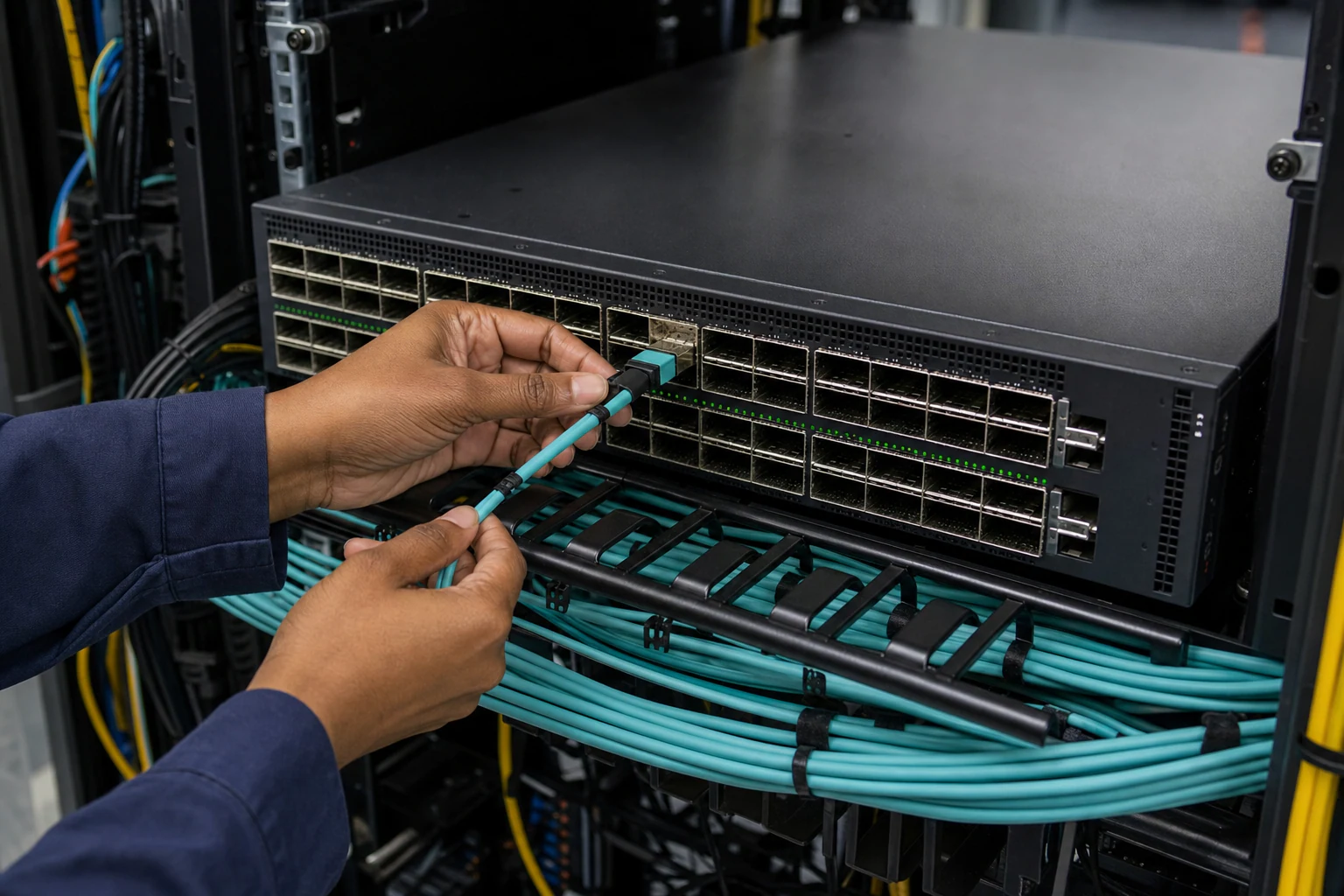
In brief
Engineering guidance on RoCE RDMA and Ethernet Fabric Design for AI Workloads for Australian network teams, covering underlay design, EVPN-VXLAN operations.
Key takeaways
- AI fabric readiness should be proven with the actual GPU node profile, NIC firmware, RoCE v2 configuration, PFC/ECN policy, optics, cabling, and telemetry stack.
- RDMA (Remote Direct Memory Access) allows one machine to read or write memory on another machine with minimal CPU involvement.
- These requirements are not exotic. They are well-understood in the networking community.
Why Ethernet Is Winning the AI Fabric Debate
AI fabric readiness should be proven with the actual GPU node profile, NIC firmware, RoCE v2 configuration, PFC/ECN policy, optics, cabling, and telemetry stack. The result should document congestion behaviour and recovery after realistic failure cases.
Understanding RoCE v2: RDMA Over Converged Ethernet
RDMA (Remote Direct Memory Access) allows one machine to read or write memory on another machine with minimal CPU involvement. RoCE v2 is the standard that carries RDMA traffic over Ethernet using UDP encapsulation, which enables routing across Layer 3 boundaries and compatibility with standard spine-leaf topologies.
Key RoCE v2 requirements for AI fabric design:
-
Lossless or near-lossless Ethernet: RDMA traffic is highly sensitive to packet drops. A single dropped packet can stall an entire GPU collective operation. This requires Priority Flow Control (PFC) or explicit congestion notification (ECN) mechanisms at every hop.
-
Consistent low latency: AI training collectives like AllReduce and AllGather require consistent sub-10-microsecond tail latency across the fabric. Variability in latency translates directly to reduced GPU utilisation.
-
Congestion management: Without proactive congestion handling, incast patterns during gradient synchronisation can cause queue build-up and packet loss. Data Center Bridging Capability Exchange Protocol (DCBX), ECN marking, and fast congestion notification mechanisms are essential.
-
Proper buffer allocation: Switch buffer depth and per-port buffer allocation must be tuned for the bursty, many-to-one traffic patterns typical of AI workloads.
These requirements are not exotic. They are well-understood in the networking community. The challenge for Australian enterprises is building a fabric that delivers all four without depending on a proprietary NOS and closed hardware supply chain.
SONiC as the Open NOS for AI Fabric Builds
Software for Open Networking in the Cloud (SONiC) is a free and open-source network operating system based on Linux that runs on switches from multiple vendors and ASICs. Originally developed and production-hardened by hyperscale cloud providers, SONiC has matured into a credible option for enterprise data center deployments, including AI fabric builds.
Why SONiC matters for AI fabric:
-
Multi-vendor hardware choice: SONiC uses the Switch Abstraction Interface (SAI) to decouple the NOS from the underlying ASIC. This means you can select switching silicon from multiple vendors while running the same operating plane. For AI fabrics, this translates to choosing the ASIC that best matches your port speed, buffer depth, and RoCE feature requirements.
-
Containerised architecture: Each network function runs in its own Docker container. This modularity simplifies upgrades, fault isolation, and troubleshooting. If you need to update your RoCE or ECN configuration, you do not have to revalidate the entire NOS image.
-
Production-proven RDMA support: SONiC includes RDMA and BGP as part of its standard feature set. RDMA over Converged Ethernet configuration, PFC, ECN, and DCBX are all supported. These are the same protocols that power the GPU backend fabrics in hyperscale environments.
-
Community and ecosystem: The SONiC Foundation, a Linux Foundation project, oversees governance and community development. The ecosystem includes major network chip vendors and a growing set of hardware platforms. For Australian buyers, this means supply chain resilience and competitive hardware pricing.
xSONiC builds on this foundation by providing SONiC-optimised switching hardware, pre-validated fabric configurations, and solution guides for AI fabric, RoCE v2, DCBX, and telemetry deployments. The goal is to reduce the integration burden that often accompanies open networking adoption.
Spine-Leaf Architecture for AI GPU Backend Fabric
The standard architecture for AI data center fabric is a leaf-spine topology. In a GPU backend fabric specifically, the design takes on additional constraints:
Leaf switches: Connect directly to GPU server NICs. Each leaf handles east-west traffic between GPU nodes within a rack or across adjacent racks. Port density and per-port buffer allocation are critical at this tier.
Spine switches: Provide non-blocking, any-to-any connectivity between leaf switches. Spine capacity determines the oversubscription ratio. For AI training workloads, a 1:1 (non-blocking) oversubscription ratio is recommended, meaning every leaf uplink has matching spine downlink capacity.
Upstream border: Separates the AI fabric from the broader data center or campus network. Traffic between the AI fabric and external services (model repositories, monitoring, user endpoints) flows through this layer.
Key design decisions for Australian enterprises:
-
Port speed: 100G leaf to server, 400G leaf to spine is a common design for current-generation GPU clusters. For larger clusters, 400G to server and 800G spine links are emerging.
-
Buffer depth: Deep-buffer switches at the leaf tier help absorb incast bursts during collective operations. Not all switching silicon offers the same buffer characteristics; this is where ASIC selection matters.
-
Fan-out and port count: The number of servers per leaf and leaves per spine determines total cluster scale. With 32-port 400G switches, a two-tier fabric can support several hundred GPU servers. Larger clusters require a three-tier Clos fabric or disaggregated chassis designs.
-
Fabric-level telemetry: For AI workloads, visibility into queue depth, congestion events, and per-flow latency is essential. Streaming telemetry and in-band network telemetry (INT) provide the data needed for both real-time troubleshooting and capacity planning.
Congestion Management: DCBX, ECN, and Fast CNP
Congestion management is the single most important operational consideration in a RoCE AI fabric. Without it, even a well-designed leaf-spine topology will degrade under the bursty, many-to-one traffic patterns of GPU collective operations.
Key mechanisms:
-
Priority Flow Control (PFC): Defined in IEEE 802.1Qbb, PFC allows a switch to signal an upstream device to pause transmission on a specific traffic class. PFC is the baseline mechanism for creating lossless behaviour on Ethernet. However, PFC alone can cause head-of-line blocking and PFC storms if not managed carefully.
-
ECN (Explicit Congestion Notification): Defined in RFC 3168, ECN marks packets when congestion is building, allowing the sender to reduce its rate before packet loss occurs. This is gentler than PFC and is the preferred first-line congestion signal for RoCE v2.
-
DCBX (Data Center Bridging Capability Exchange Protocol): DCBX automatically negotiates PFC, ECN, and other DCB parameters between directly connected devices. This simplifies initial fabric bring-up and ensures consistent configuration across the fabric.
-
Fast CNP (Congestion Notification Packet): Some implementations add fast CNP generation at the switch level, providing faster feedback to RDMA senders than relying solely on end-to-end ECN marking.
The xSONiC approach includes solution guides for each of these mechanisms, providing tested configuration templates that can be applied to SONiC-based switches. The objective is to reduce the trial-and-error cycle that teams often face when deploying RoCE fabrics for the first time.
Telemetry and Observability for AI Fabrics
AI training jobs are resource-intensive and time-sensitive. Network issues that would be tolerable in a general-purpose data center can cause significant cost overruns in an AI environment, as GPU time is expensive and training runs can take hours or days.
Key telemetry capabilities for AI fabric operations:
-
Streaming telemetry: Push-based telemetry exports (gNMI, gRPC) provide near-real-time visibility into interface counters, queue depths, buffer utilisation, and error rates. SONiC supports streaming telemetry natively.
-
In-band network telemetry (INT): INT embeds metadata in packet headers as they traverse the fabric, allowing operators to measure per-hop latency, queue occupancy, and congestion events at line rate. This is particularly valuable for identifying micro-congestion that does not show up in aggregate counters.
-
IPTPath telemetry: Provides path-level visibility for traffic flows, helping operators understand exactly which path an RDMA flow takes through the fabric and where latency is introduced.
-
Flow-level analytics: Understanding which flows are consuming bandwidth, which GPU pairs are generating the most traffic, and where incast patterns form enables proactive capacity planning.
For Australian organisations operating AI clusters, the combination of SONiC-native telemetry and xSONiC’s telemetry solution guides provides a practical path to operational visibility without requiring a proprietary monitoring stack.
Optics and Cabling Considerations for AI Fabric
The physical layer of an AI fabric deserves careful planning. As port speeds increase from 100G to 400G and 800G, optics selection impacts both cost and operational flexibility.
-
100G: SFP28 for server connections, QSFP28 for switch-to-switch links. Mature, cost-effective, well-understood.
-
400G: QSFP-DD and OSFP form factors. Transceiver selection depends on reach: DAC (Direct Attach Copper) for short rack-to-rack distances, AOC (Active Optical Cable) for medium runs, and SR4/DR4/FR4 optics for longer fibre runs.
-
800G: OSFP and emerging form factors. Co-packaged optics are entering the market, as seen in NVIDIA’s Spectrum-6 SN6000 series, which uses MMC-12 co-packaged optics connectors for 800G port speeds. This is a significant shift in how switching hardware is designed and cooled.
For Australian data centers, the availability of high-speed optics and the cost of fibre plant upgrades are practical constraints. xSONiC’s optical transceiver portfolio covers SFP, SFP+, SFP28, QSFP28, QSFP-DD, and OSFP form factors, providing options for both current and next-generation fabric builds.
Open Networking vs Proprietary AI Fabric: A Buyer Comparison
Australian enterprises evaluating AI fabric options face a fundamental choice between proprietary and open networking approaches. This is not a simple cost comparison; it involves operational model, vendor risk, and long-term flexibility.
Proprietary approach (e.g., InfiniBand, vendor-locked Ethernet):
- Tightly integrated stack with single-vendor support
- Often includes optimised congestion management and telemetry out of the box
- Higher per-port cost and limited hardware supply chain options
- Vendor roadmap alignment required for future upgrades
Open networking approach (e.g., SONiC on multi-vendor hardware):
- NOS decoupled from hardware via SAI abstraction
- Multi-vendor ASIC and switch hardware supply chain
- Community-driven feature development with enterprise distribution options
- Requires more integration effort but provides greater long-term flexibility
- Growing ecosystem of validated configurations and solution guides
The xSONiC value proposition sits in the middle: open networking hardware and SONiC software, combined with pre-validated fabric configurations, solution guides, and professional support. This reduces the integration overhead that is the most commonly cited concern with open networking adoption.
Practical Steps for Australian Enterprises Starting an AI Fabric Build
For organisations in Australia evaluating or beginning an AI fabric deployment, the following steps provide a structured approach:
-
Define GPU cluster scale and interconnect requirements: Determine the number of GPU servers, per-server NIC count and speed, and collective communication patterns. This drives the fabric topology and port count requirements.
-
Select switching silicon and hardware: Evaluate ASIC options based on port speed, buffer depth, RoCE feature support, and power consumption. SONiC-compatible hardware from multiple vendors gives you leverage in procurement.
-
Choose and validate NOS: SONiC provides the open-source foundation. For enterprise deployments, evaluate whether an enterprise SONiC distribution with commercial support meets your operational requirements.
-
Design the fabric topology: Leaf-spine with non-blocking or low-oversubscription ratios. Plan for growth; AI clusters tend to expand faster than initially projected.
-
Configure congestion management: Deploy PFC, ECN, DCBX, and fast CNP mechanisms. Use tested configuration templates as a starting point, then tune based on observed workload patterns.
-
Implement telemetry: Enable streaming telemetry from day one. For larger clusters, add INT and path-level telemetry for granular visibility.
-
Test with representative workloads: Validate fabric performance using the actual AI training frameworks (e.g., PyTorch Distributed, NCCL) and collective operations that your team will run in production.
xSONiC provides solution guides for each of these steps, from AI Fabric and RoCE v2 configuration to DCBX, Fast CNP, and INT telemetry. The guides are designed to help networking teams that are experienced in traditional data center design but new to AI-specific fabric requirements.
The Road Ahead: 800G, Co-Packaged Optics, and AI Fabric Scale
The next wave of AI fabric infrastructure is already being defined. 800G Ethernet switching is entering the market, with platforms like the NVIDIA Spectrum-6 SN6000 series offering 102.4 Tb/s throughput using co-packaged silicon photonics. Co-packaged optics eliminate the pluggable transceiver module, integrating optical connectivity directly into the switch ASIC package. This brings potential benefits in power efficiency, thermal management, and reliability, though it also changes the operational model for optics replacement and troubleshooting.
For Australian enterprises, the practical takeaway is this: plan your current fabric build with an eye toward 400G to 800G upgrade paths. Select switching platforms that support higher port speeds through software and optics upgrades, not just fixed-speed hardware. Open networking platforms like SONiC, combined with modular hardware, provide the most flexible path forward as AI workload requirements continue to scale.
Engineering Evidence Floor
For this topic, treat the article as buyer-ready only when the fabric claim is tied to measurable acceptance data. The baseline evidence package should include the selected switch SKU, SONiC image, ASIC/SAI version, NIC firmware, optics list, RoCE policy, telemetry counters, support owner, and rollback method. In a small pilot, capture at least 30 minutes of traffic at the intended 100G/400G/800G speed, one link failure, one switch reboot, one optics fault, and one support handoff. That evidence separates a credible AI fabric plan from a bandwidth brochure.
| Evidence area | What to validate | Acceptance gate | Rework trigger |
|---|---|---|---|
| Transport | PFC, ECN, DCBX, MTU, queue mapping, and CNP counters | 30 minutes load test at 100G/400G/800G | RoCE is asserted but not measured |
| Platform | Switch SKU, ASIC, SAI, SONiC image, and optics list | 2 switch roles pass upgrade and rollback | Generic compatibility is used as proof |
| Failure | Link loss, switch reboot, route convergence, and workload impact | 3 failure cases captured with timestamps | Steady-state throughput is the only evidence |
| Telemetry | Queue depth, drops, optics DOM, gNMI, and packet visibility | Operators explain a slowdown within 15 minutes | GPU and network teams use different data |
| Support | APAC escalation, RMA, spares, and patch lifecycle | 12 months operating plan approved | Ownership splits across vendors |
Engineering FAQ
What should be proven before adopting EVPN-VXLAN on SONiC? Prove underlay routing, BGP sessions, VTEP behaviour, MAC/IP learning, route scale, multi-homing design, failure convergence, and observability. The overlay should be accepted as a system, not a feature checkbox.
Why does the underlay design still matter in an overlay network? EVPN-VXLAN depends on a stable routed underlay. MTU, ECMP, addressing, route policy, link failure behaviour, and telemetry determine whether the overlay remains predictable under load and during faults.
What should be included in an EVPN-VXLAN operations runbook? Include naming, IP plan, BGP policy, VNI mapping, change process, rollback commands, failure checks, telemetry fields, backup and restore steps, and escalation ownership for the selected SONiC image.
Related xSONiC Resources
Sources Reviewed
- Ethernet Network Adapters - ConnectX NICs | NVIDIA
- NVIDIA BlueField Data Processing Unit
- NVIDIA Spectrum-X Ethernet Platform
- OpenConfig gNMI Specification
- OpenConfig
- RFC 7950 - The YANG 1.1 Data Modeling Language
- RFC 6241 - Network Configuration Protocol (NETCONF)
- SONiC Project Documentation
- Broadcom Ethernet Switching
- Marvell Switching
- NVIDIA Ethernet Switching
- Open Compute Networking
- SONiC GitHub
- SONiC Foundation
Product fit
Products referenced for evaluation
These products are referenced for evaluation context in the article. Confirm workload, port, optics, software, interoperability, and support requirements against the exact deployment before procurement.
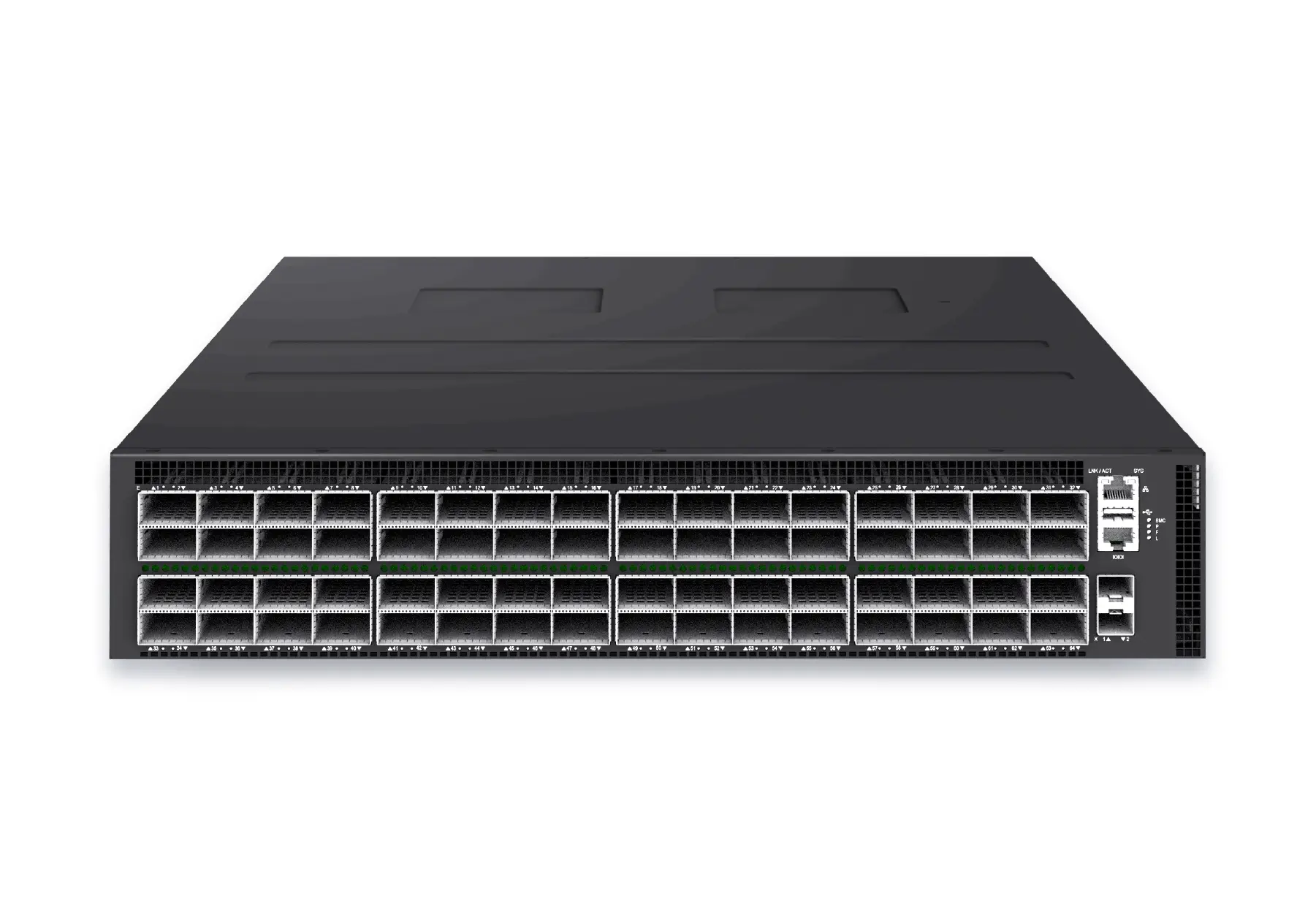 datacenter aiXS-DC-64X800-AI-G164-port 800G AI fabric switch for large-scale GPU clusters, HPC backbones, and ultra-high-throughput data center networks.View product
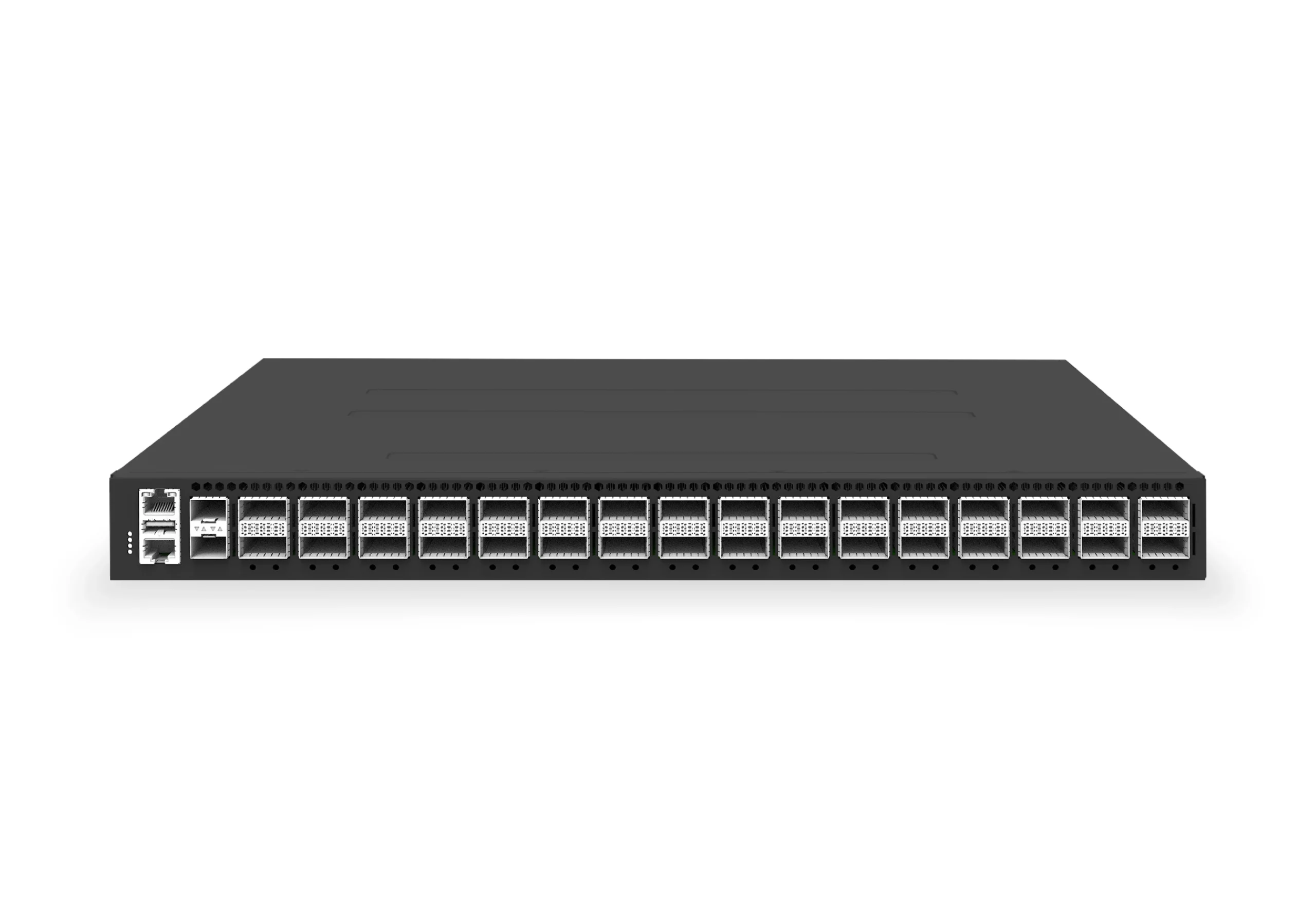 datacenter aiXS-DC-32X400-SP-G232-port 400G spine/core switch for high-capacity data center fabrics and AI-ready backbones.View product
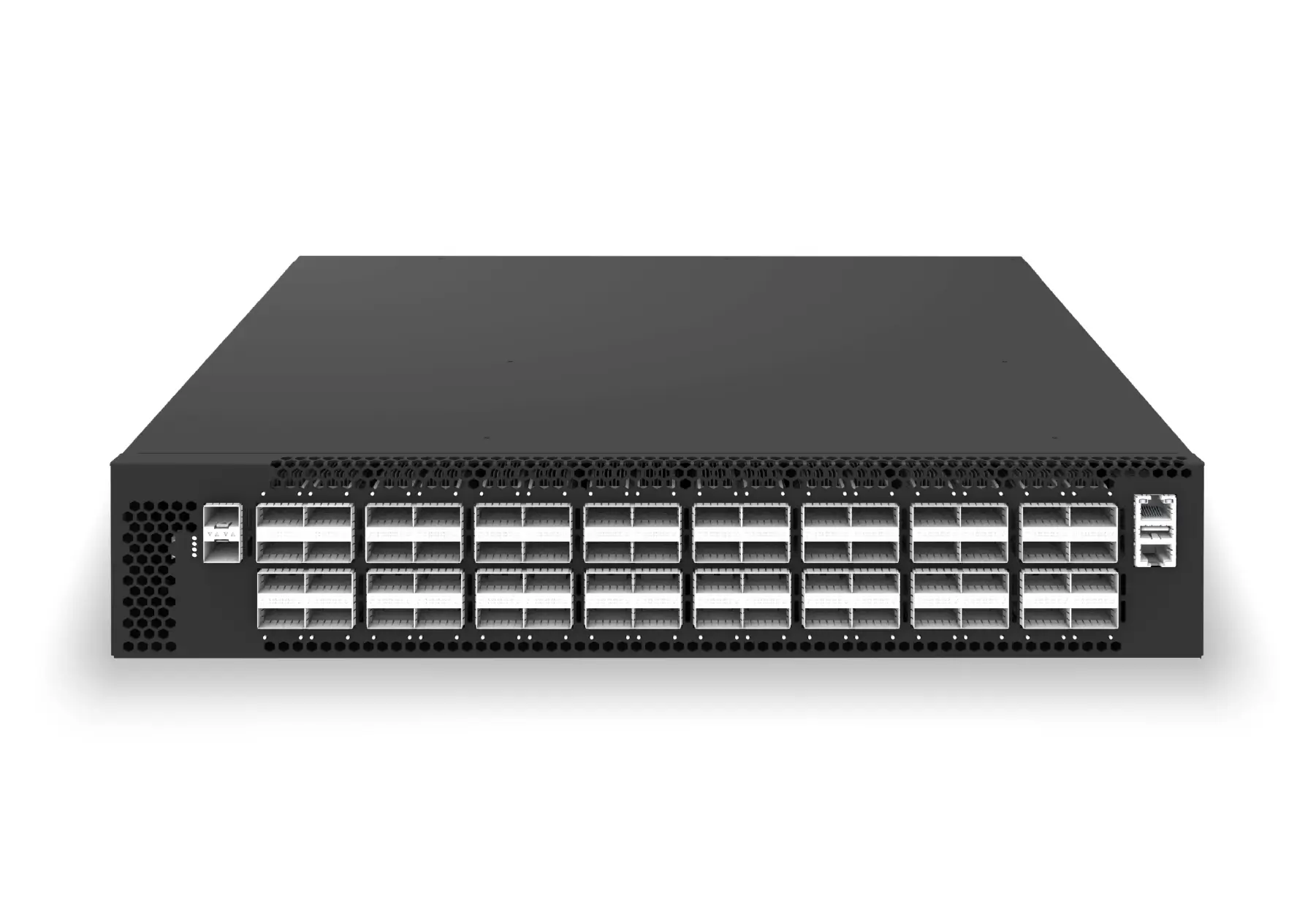 datacenter aiXS-DC-64X200-LS-G164-port 200G leaf/spine switch for high-bandwidth storage, compute, and scale-out data center fabrics.View product
Continue reading
Related articles
 Technical ArticleDesigning GPU Backend Fabrics with RoCE v2: How SONiC 400G/800G Switches Transform AI Data CentersEngineering guide for AI fabric buyers covering RoCE, SONiC, telemetry, optics, support ownership, and deployment validation.Read article
 Technical ArticleWhy Open SONiC Ethernet Is Becoming the Default AI Fabric for GPU Backend ClustersEngineering guidance on Open SONiC Ethernet Is Becoming the Default AI Fabric for GPU Backend Clusters for Australian network teams, covering underlay design.Read article
 Technical ArticleGPU Cluster Fabric Design: Why AI Workloads Need Purpose-Built EthernetArchitecture guide to GPU cluster fabrics covering RoCE v2, PFC, ECN, DCBX, SONiC, 400G/800G, telemetry, InfiniBand trade-offs, and acceptance evidence.Read article