
In brief
Engineering guidance on Private AI Inference GPU Networking Deployment Playbook for Australian data centre buyers, covering form factor choice, link budgets, cabling.
Key takeaways
- Australian enterprises deploying private LLM inference, RAG pipelines, and multimodal AI services on premises face a networking challenge that traditional data center designs do not solve.
- The result is a growing gap between campus or general-purpose data center networks and the traffic patterns of GPU-backed inference.
- This playbook walks through the design, sizing, and deployment decisions for a private AI inference fabric built on SONiC-based spine-leaf switching, RoCE v2 transport, and supporting telemetry.
Why Private AI Inference Needs Its Own Network Architecture
Australian enterprises deploying private LLM inference, RAG pipelines, and multimodal AI services on premises face a networking challenge that traditional data center designs do not solve. GPU inference servers generate bursty, high-bandwidth traffic between NICs, storage, and model-serving endpoints. Unlike training clusters that tolerate some throughput variance, inference workloads demand consistent low latency to meet service-level objectives for token generation times.
The result is a growing gap between campus or general-purpose data center networks and the traffic patterns of GPU-backed inference. Proprietary AI networking stacks address this gap, but they lock buyers into single-vendor ecosystems. SONiC (Software for Open Networking in the Cloud), the Linux Foundation-backed open-source network operating system, offers an alternative: a containerized, multi-vendor NOS that supports BGP, RDMA, and the lossless Ethernet features that AI fabrics require.
This playbook walks through the design, sizing, and deployment decisions for a private AI inference fabric built on SONiC-based spine-leaf switching, RoCE v2 transport, and supporting telemetry. It is written for Australian network architects, infrastructure leads, and platform teams evaluating on-premises GPU infrastructure networking.
Fabric Topology Decision Criteria
A spine-leaf Clos fabric is the standard topology for AI data center networking. The decision criteria for sizing a private AI inference fabric depend on three variables: the number of GPU inference nodes, the per-node NIC bandwidth, and the target oversubscription ratio.
Decision Table: Spine-Leaf Sizing for AI Inference
| Criterion | Small (8-32 GPUs) | Medium (32-128 GPUs) | Large (128-512 GPUs) |
|---|---|---|---|
| Leaf switch ports | 48x 25G + 8x 100G uplinks | 32x 100G server-facing | 64x 100G or 400G server-facing |
| Spine switch ports | 2-4 spines, 100G | 2-4 spines, 400G | 4-8 spines, 400G/800G |
| Oversubscription | 3:1 acceptable | 2:1 recommended | 1:1 preferred for inference |
| Fabric bandwidth per GPU | 25-50 Gbps | 50-100 Gbps | 100-200 Gbps |
| Leaf uplink type | 100G optical | 400G optical | 400G or 800G optical |
The spine count scales with east-west traffic volume. Each spine adds path diversity and reduces the blast radius of a single switch failure. For inference workloads, where a single leaf may host four to eight GPU servers, two spines is the practical minimum; four spines is recommended for any deployment above 64 GPUs.
SONiC as the Network Operating System: Why Open Networking Fits AI Fabric
SONiC is an open-source network operating system built on a containerized Linux architecture. According to the SONiC Foundation, it decouples hardware from software via the Switch Abstraction Interface (SAI), runs on switches from multiple vendors and ASICs, and offers a full suite of network functionality including BGP and RDMA that has been production-hardened in hyperscale data centers.
For private AI inference fabric builds in Australia, SONiC offers three practical advantages:
-
Multi-vendor hardware choice. SONiC runs on switches based on Broadcom, Marvell, and other switching ASICs. This means an infrastructure team can select switches from multiple vendors while maintaining a single NOS and automation surface. This is particularly relevant in the Australian market where supply chain lead times can vary between vendors.
-
RDMA and RoCE v2 support. GPU backend fabrics rely on RDMA over Converged Ethernet v2 (RoCE v2) for low-latency, zero-copy data transfers between GPU memory regions. SONiC supports the DCBX, PFC, and ECN features that lossless Ethernet requires for RoCE transport. These are configurable through SONiC’s JSON-based configuration model.
-
Containerized architecture for operational isolation. SONiC runs each network function in its own Docker container. This design provides fault isolation, simplifies troubleshooting, and allows independent upgrades of protocol stacks. For teams managing AI inference fabrics alongside general-purpose data center networks, this isolation reduces the risk of cross-domain configuration conflicts.
NVIDIA also offers Pure SONiC as a community-developed open-source NOS for their Spectrum Ethernet switch portfolio, providing another pathway for teams that want to pair SONiC with specific switching silicon. The SONiC project is licensed under Apache License 2.0 and supported by an active open-source community.
RoCE v2 Transport and Lossless Ethernet Configuration
RoCE v2 is the dominant transport protocol for GPU backend fabrics. It enables RDMA operations over standard Ethernet, allowing GPU servers to transfer model weights, KV cache data, and intermediate tensor results directly between memory without CPU involvement.
However, RoCE v2 requires a lossless or near-lossless Ethernet layer. Packet drops cause RDMA retransmissions that spike latency by orders of magnitude. The configuration stack for lossless RoCE involves three interdependent features:
Priority Flow Control (PFC): PFC is an IEEE 802.1Qbb mechanism that allows a receiving switch or NIC to send a PAUSE frame for a specific traffic class when its buffer fills. In a GPU inference fabric, PFC should be enabled on the traffic class carrying RoCE v2 traffic (typically DSCP 26, mapped to priority 3 or 4). PFC prevents packet drops but can introduce head-of-line blocking if buffers are not sized correctly.
Data Center Bridging Capability Exchange (DCBX): DCBX is the LLDP-based protocol that negotiates PFC, ETS (Enhanced Transmission Selection), and application priority settings between peers. SONiC supports DCBX configuration for automated negotiation of lossless parameters between switches and NICs. See the xSONiC DCBX technology guide for detailed configuration walkthroughs.
Explicit Congestion Notification (ECN) with Fast CNP: ECN marks packets at switch egress queues when congestion thresholds are exceeded. The receiving NIC sends Congestion Notification Packets (CNPs) back to the sender, which throttles its injection rate. Fast CNP mechanisms accelerate this feedback loop. This is the recommended complement to PFC for managing congestion without relying solely on pause frames.
Deployment Checklist: Lossless RoCE v2 Fabric
- Define traffic class mapping: RoCE v2 on dedicated priority (DSCP 26 to PCP 3 or 4)
- Configure PFC on all spine and leaf ports for the RoCE traffic class
- Enable DCBX on all server-facing and inter-switch links
- Set ECN marking thresholds based on switch buffer depth and expected burst sizes
- Configure Fast CNP on NIC endpoints (verify NIC driver and firmware support)
- Validate buffer allocation: shared buffer pools should reserve headroom for PFC pause propagation
- Test under load: generate synthetic RDMA traffic to verify zero drops and acceptable P99 latency
- Verify PFC deadlock detection and recovery mechanisms are enabled
Optical Connectivity and Transceiver Planning
The physical layer of an AI inference fabric depends on the link speeds between tiers. Typical configurations use:
- Leaf to server: 25G SFP28 or 100G QSFP28, depending on GPU server NIC capability
- Leaf to spine: 100G QSFP28, 400G QSFP-DD, or 800G OSFP uplinks
- Spine to super-spine (if applicable): 400G or 800G
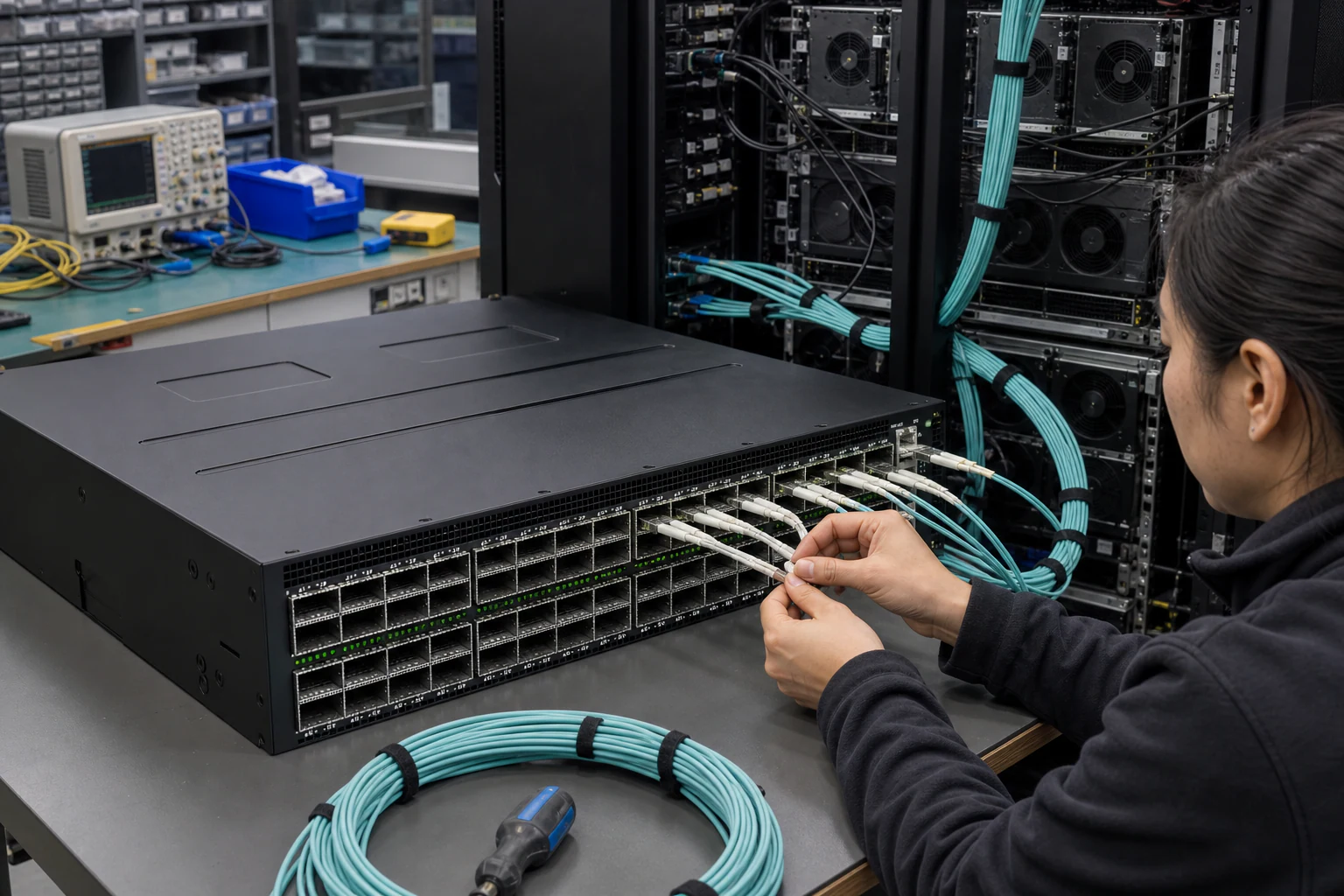
Transceiver selection affects both cost and lead time. For Australian deployments, pluggable optical transceivers in SFP28, QSFP28, QSFP-DD, and OSFP form factors should be sourced from suppliers that carry local stock or can guarantee delivery within project timelines. Direct attach copper (DAC) cables are suitable for short leaf-to-server runs within the same rack (typically under 5 meters). Active optical cables (AOC) and individual transceivers with fiber patch cords are required for longer inter-rack runs.
Transceiver Planning Checklist:
- Catalog all link types and distances in the fabric topology diagram
- Select transceiver form factors per link tier (SFP28, QSFP28, QSFP-DD, OSFP)
- Specify fiber type: single-mode for inter-rack, multi-mode for intra-rack where distance permits
- Confirm transceiver compatibility with chosen switch platform and SONiC version
- Order spares (recommended 10-15% buffer for optics and fiber patch cords)
- Validate import and customs timelines for Australian delivery
Telemetry and Observability for AI Inference Fabrics
AI inference workloads produce traffic patterns that are difficult to diagnose with traditional SNMP-based monitoring. Microbursts, RDMA queue depth fluctuations, and PFC storm events can cause intermittent latency spikes that do not appear in five-minute polling averages.
Two SONiC-compatible telemetry approaches address this gap:
INT (In-band Network Telemetry): INT inserts metadata into packets at each switch hop, recording queue depth, latency, and egress port information. This provides hop-by-hop visibility into fabric congestion. INT data can be exported to external collectors for analysis and alerting. See the xSONiC INT technology guide for architecture details.
IPTPath Telemetry: IPTPath provides path-level telemetry that traces the actual forwarding path of packets through the fabric. This is useful for validating equal-cost multipath (ECMP) load balancing across spine links, which directly affects GPU backend performance.
Recommended Observability Stack:
- Deploy gNMI-based streaming telemetry from SONiC switches to a collector (e.g., Prometheus, Telegraf, or commercial NMS)
- Enable INT or IPTPath for east-west GPU traffic monitoring
- Configure PFC and ECN counter collection with per-interface granularity
- Set alerting thresholds for PFC pause frame counts, ECN-marked packet ratios, and queue depth
- Integrate network telemetry with GPU monitoring (e.g., NVIDIA DCGM) for correlated analysis
Engineering FAQ
What should be checked before ordering 400G or 800G optics? Check port form factor, lane speed, reach, fibre type, breakout plan, DOM telemetry, firmware compatibility, thermal budget, and the switch vendor optics support matrix. The same speed can behave differently across QSFP-DD, OSFP, DAC, AOC, and fibre modules.
Why is optics validation part of a SONiC deployment? SONiC exposes the NOS layer, but optics behaviour still depends on the switch platform, transceiver EEPROM data, firmware, thermal design, and operational tooling. Buyers should test the exact module and cable combination before volume rollout.
What should be included in an optics procurement record? Record SKU, reach, connector, fibre type, temperature class, supported breakout modes, switch platform, SONiC image, DOM fields, link test result, and spare strategy. That record becomes the reference for future replacements.
Related xSONiC Resources
Sources Reviewed
- Ethernet Network Adapters - ConnectX NICs | NVIDIA
- NVIDIA BlueField Data Processing Unit
- NVIDIA Spectrum-X Ethernet Platform
- OpenConfig gNMI Specification
- OpenConfig
- RFC 7950 - The YANG 1.1 Data Modeling Language
- RFC 6241 - Network Configuration Protocol (NETCONF)
- SONiC Project Documentation
- Broadcom Ethernet Switching
- Marvell Switching
- NVIDIA Ethernet Switching
- Open Compute Networking
- SONiC GitHub
- SONiC Foundation
Product fit
Products referenced for evaluation
These products are referenced for evaluation context in the article. Confirm workload, port, optics, software, interoperability, and support requirements against the exact deployment before procurement.
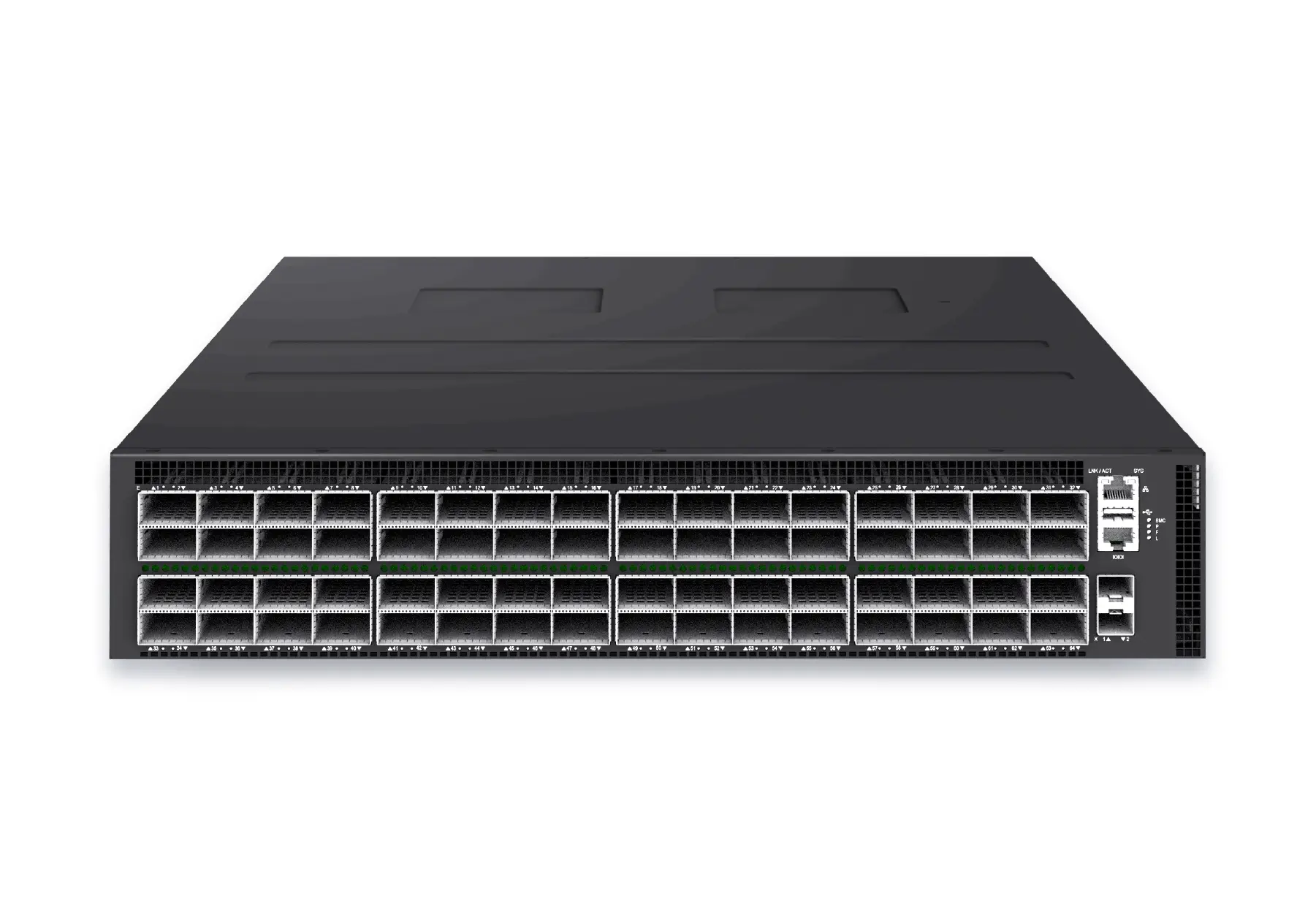 datacenter aiXS-DC-64X800-AI-G164-port 800G AI fabric switch for large-scale GPU clusters, HPC backbones, and ultra-high-throughput data center networks.View product
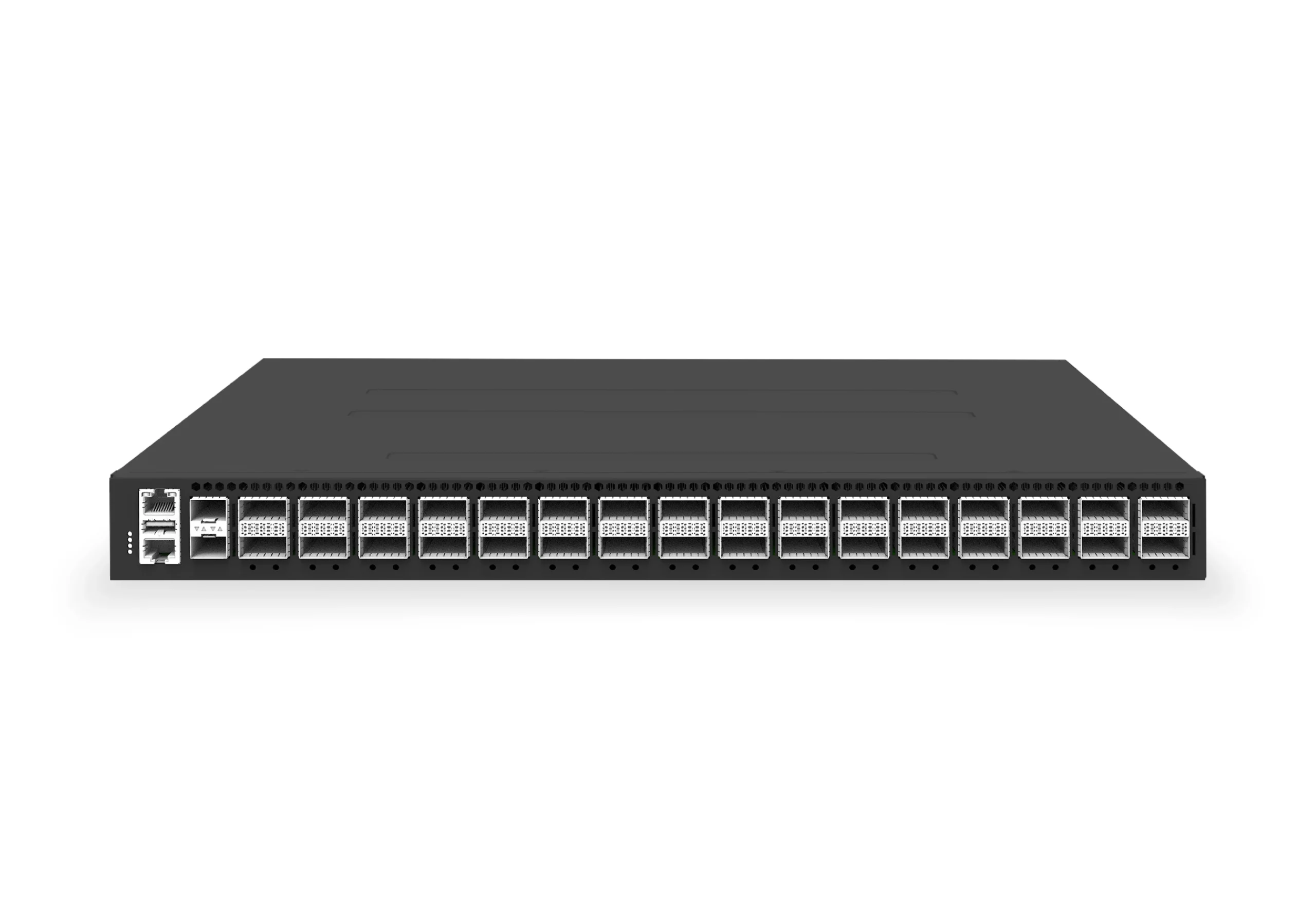 datacenter aiXS-DC-32X400-SP-G232-port 400G spine/core switch for high-capacity data center fabrics and AI-ready backbones.View product
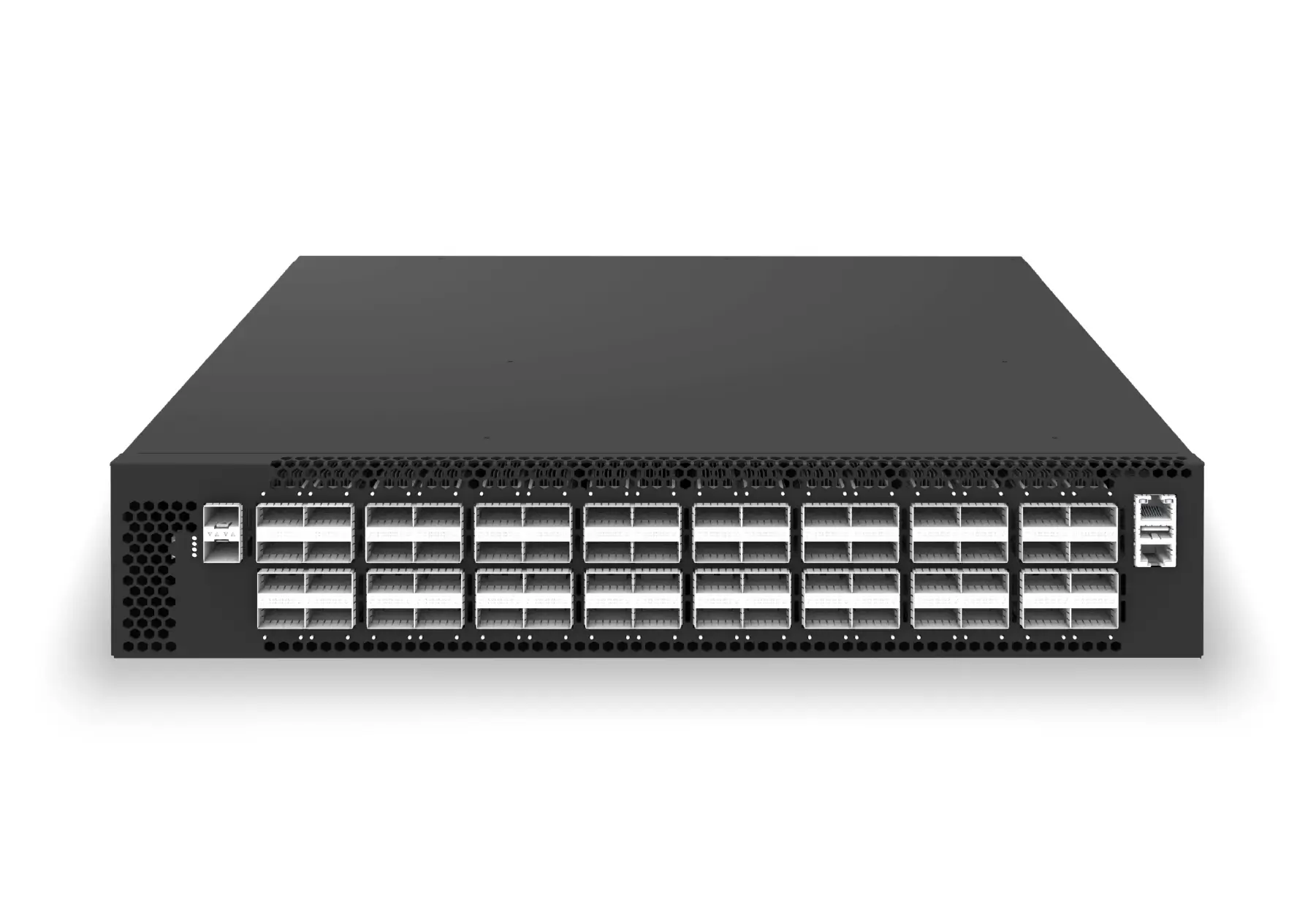 datacenter aiXS-DC-64X200-LS-G164-port 200G leaf/spine switch for high-bandwidth storage, compute, and scale-out data center fabrics.View product
Continue reading
Related articles
 Technical ArticleDesigning GPU Backend Fabrics with RoCE v2: How SONiC 400G/800G Switches Transform AI Data CentersEngineering guide for AI fabric buyers covering RoCE, SONiC, telemetry, optics, support ownership, and deployment validation.Read article
 Technical ArticleWhy Open SONiC Ethernet Is Becoming the Default AI Fabric for GPU Backend ClustersEngineering guidance on Open SONiC Ethernet Is Becoming the Default AI Fabric for GPU Backend Clusters for Australian network teams, covering underlay design.Read article
 Technical ArticleGPU Cluster Fabric Design: Why AI Workloads Need Purpose-Built EthernetArchitecture guide to GPU cluster fabrics covering RoCE v2, PFC, ECN, DCBX, SONiC, 400G/800G, telemetry, InfiniBand trade-offs, and acceptance evidence.Read article