In brief
An engineering comparison of InfiniBand and Ethernet/RoCE for Australian private AI infrastructure, covering latency, lossless transport, support, scale, TCO, and pilot tests.
Key takeaways
- When Australian enterprise teams plan a private AI infrastructure deployment -- whether for LLM fine-tuning, RAG pipelines, or GPU inference services -- the network interconnect is the architectural decision that everything else depends on.
- This article provides a source-backed evaluation of both technologies from the perspective of an Australian enterprise building or upgrading a private AI cluster.
- InfiniBand is a high-speed, low-latency interconnect standard that originated in 1999 from the merger of two competing I/O projects: Intel-led NGIO and the IBM/Compaq/HP-led Future I/O initiative.
The Interconnect Decision That Shapes Your Entire AI Stack
When Australian enterprise teams plan a private AI infrastructure deployment — whether for LLM fine-tuning, RAG pipelines, or GPU inference services — the network interconnect is the architectural decision that everything else depends on. Choose wrong, and your GPUs sit idle waiting for data. Choose right, and you unlock the full throughput of your compute investment.
This article provides a source-backed evaluation of both technologies from the perspective of an Australian enterprise building or upgrading a private AI cluster. It does not declare a universal winner. Instead, it maps the trade-offs so your team can make an informed decision aligned with your workloads, budget, and operational reality.
What InfiniBand Actually Is
InfiniBand is a high-speed, low-latency interconnect standard that originated in 1999 from the merger of two competing I/O projects: Intel-led NGIO and the IBM/Compaq/HP-led Future I/O initiative. The InfiniBand Trade Association (IBTA) released the 1.0 specification in 2000.
Unlike Ethernet, which was designed for general-purpose LAN and WAN networking, InfiniBand was purpose-built for server-to-server and server-to-storage communication in tightly coupled computing environments. Its core design principles include:
- Remote Direct Memory Access (RDMA) as a native capability, not an add-on
- Credit-based flow control at the link layer, making the network inherently lossless
- Cut-through switching that reduces forwarding latency to under 100 nanoseconds
- A switched fabric topology with centralized subnet management
- Hardware-offloaded transport layer processing, bypassing the host CPU
InfiniBand uses a five-layer architecture: physical, link, network, transport, and upper layers. The transport layer is hardcoded into the Host Channel Adapter (HCA) hardware, unlike TCP/IP which runs in the operating system kernel. This kernel-bypass mechanism is what enables InfiniBand to achieve sub-microsecond application-to-application latency.
Since 2019, when NVIDIA acquired Mellanox for USD 6.9 billion, NVIDIA has been the sole major supplier of InfiniBand hardware. The current flagship platform is the Quantum-X800, with NDR (400 Gbps per port) and XDR (800 Gbps per port) generations now shipping or announced.
How Ethernet Caught Up: The RoCEv2 Story
Ethernet has evolved dramatically from its origins as a shared-medium LAN technology. Modern data center Ethernet operates at 100G, 400G, and 800G line rates using the same PAM4 signaling that InfiniBand adopted for HDR and NDR generations.
The critical development was RoCE (RDMA over Converged Ethernet), introduced around 2010, and its successor RoCEv2 in 2014. RoCEv2 enables RDMA operations over standard Ethernet using UDP/IP encapsulation, delivering many of the same kernel-bypass and zero-copy benefits that InfiniBand pioneered.
To approach InfiniBand’s lossless behavior, Ethernet added several mechanisms:
- Priority Flow Control (PFC, IEEE 802.1Qbb): pauses traffic on specific priority classes to prevent buffer overflow
- Explicit Congestion Notification (ECN, IEEE 802.1Qau): signals congestion before packet loss occurs
- Data Center Bridging Capability Exchange Protocol (DCBX): auto-negotiates lossless configuration between endpoints
- RDMA congestion notification, sometimes called Fast CNP, to react quickly to congestion events
The Ultra Ethernet Consortium (UEC), formed in 2023 by a broad industry coalition, is driving further enhancements to Ethernet specifically for AI and HPC workloads, signaling that Ethernet will continue to close the performance gap.
The practical result: Ethernet with RoCEv2 can deliver latency in the 10 to 50 microsecond range for application-to-application transfers, compared to roughly 1 microsecond for InfiniBand. For many AI training and inference workloads, this difference is operationally acceptable, especially when weighed against cost, ecosystem, and flexibility advantages.
Head-to-Head: The Dimensions That Matter for Private AI
The following comparison synthesizes findings from multiple industry sources and vendor documentation. All latency and bandwidth figures are approximate and depend on specific hardware, cable length, and configuration.
Latency and Determinism
InfiniBand delivers the lowest latency in the market. With RDMA native to the architecture and hardware-offloaded transport, application-to-application latency is typically around 1 microsecond. The credit-based flow control ensures deterministic behavior: packets are never dropped due to congestion, and timing is predictable.
Ethernet with RoCEv2 achieves 10 to 50 microseconds in well-tuned deployments. The range is wider because Ethernet’s lossless behavior depends on correct PFC/ECN/DCBX configuration across the entire fabric. Misconfiguration can lead to priority flow control deadlock (PFC storms), head-of-line blocking, or unexpected packet drops.
For AI training with large collective operations (all-reduce, all-to-all), InfiniBand’s NVIDIA SHARP technology offloads these operations directly into the switch network, reducing data movement and accelerating synchronization. Ethernet has no equivalent native in-network computing capability, though some switch vendors are beginning to explore similar concepts.
Bottom line: InfiniBand wins on raw latency and determinism. Ethernet with RoCEv2 is competitive for most AI workloads but requires careful tuning.
Bandwidth: Largely Parity at the Top End
Both technologies now ship at comparable aggregate bandwidths:
- InfiniBand: HDR (200 Gbps per 4x port), NDR (400 Gbps), XDR (800 Gbps)
- Ethernet: 200GbE, 400GbE, 800GbE
Both use PAM4 signaling at the physical layer for the latest generations. Both use QSFP-family and OSFP connectors. The optical transceiver and direct attach cable (DAC/AOC) ecosystems overlap significantly.
Where they differ is in sustained throughput under load. InfiniBand’s lossless architecture means it can sustain near-peak bandwidth even under heavy congestion. Ethernet can approach this with properly configured PFC/ECN, but the behavior is configuration-dependent rather than architecture-guaranteed.
For AI training clusters moving large tensor batches between GPUs, sustained throughput matters more than peak line rate. This is where InfiniBand’s architecture still holds an advantage, though the gap narrows with each Ethernet generation.
Cost and Total Cost of Ownership
This is where Ethernet has a decisive advantage for most Australian enterprises.
InfiniBand hardware (switches, HCAs, cables) tends to cost more than comparable Ethernet equipment. More importantly, the InfiniBand ecosystem is effectively a single-vendor market: NVIDIA. This means:
- Limited price competition on switches and adapters
- Vendor-dependent upgrade cycles and roadmap control
- Specialized expertise required for deployment and troubleshooting
- Fewer qualified networking engineers in the Australian job market
Ethernet, by contrast, is a multi-vendor ecosystem with broad interoperability. Switches are available from multiple ASIC vendors (Broadcom, Marvell, and others) and multiple system vendors. The RoCEv2 protocol is an open standard. SONiC (Software for Open Networking in the Cloud) and other open-source network operating systems run on a wide range of Ethernet switches.
For Australian enterprises, the practical implications are significant:
- More supply chain options and less geographic dependency on a single vendor’s Australian distribution
- Larger pool of engineers with Ethernet fabric experience
- Lower per-port cost for equivalent bandwidth
- Easier integration with existing data center network infrastructure
Scalability and Topology
InfiniBand subnets support up to approximately 65,536 nodes with a single subnet manager. For very large AI training clusters (thousands of GPUs), InfiniBand’s fat-tree and Dragonfly+ topologies are well-proven. The centralized subnet manager assigns Local Identifiers (LIDs) and programs forwarding tables, eliminating broadcast storms.
Ethernet scales differently: it uses IP-based routing (BGP, OSPF, or EVPN-VXLAN overlays) which is practically unlimited in scale. For enterprise private AI clusters typically ranging from 8 to 512 GPUs, Ethernet spine-leaf architectures are well-understood and straightforward to deploy.
The centralized management model of InfiniBand (Subnet Manager) is both a strength and a weakness. It simplifies fabric management but introduces a single point of management authority. Ethernet’s distributed routing model is more resilient to management plane failures but requires more configuration expertise.
For most Australian enterprise AI deployments (not hyperscaler scale), Ethernet’s scalability is more than sufficient.
Ecosystem, Skills, and Operational Reality in Australia
This dimension is often underweighted in technical evaluations but matters enormously for private AI infrastructure success.
Australia’s data center and networking workforce is predominantly Ethernet-trained. Cisco, Arista, and open networking (SONiC) skills are widely available. InfiniBand expertise is concentrated in a small number of HPC sites (national research labs, university clusters) and is not broadly available in enterprise IT teams.
When your AI cluster has a fabric issue at 2 AM, the question is: can your operations team diagnose and fix it? With Ethernet, the answer is almost certainly yes. With InfiniBand, you may need to escalate to vendor support or a specialist consultant.
Additionally, AI infrastructure does not exist in isolation. It connects to storage (NVMe over Fabrics), management networks, user access networks, and external data sources. Ethernet handles all of these with the same protocol family and often the same switching infrastructure. InfiniBand requires gateway systems to bridge to Ethernet for non-IB traffic, adding cost and operational complexity.
The Open Ethernet Alternative: What It Looks Like in Practice
For Australian enterprises that want AI-fabric-grade performance without single-vendor lock-in, an open Ethernet/RoCEv2 fabric built on high-performance switches is a credible alternative. Here is what a typical deployment looks like:
- Spine-leaf architecture using 400GbE switches with RoCEv2-enabled ports
- PFC, ECN, and DCBX configured for lossless RDMA transport
- Congestion notification (Fast CNP) enabled for responsive flow control
- Network telemetry (INT) for real-time visibility into fabric behavior
- Open NOS (SONiC or similar) for operational consistency and automation
- 400G optical transceivers and DAC/AOC for interconnect cabling
- GPU servers with RoCEv2-capable NICs (multiple vendors available)
This architecture delivers deterministic, low-latency transport for AI collective operations while keeping the operational model familiar to Ethernet-trained teams and the supply chain diverse.
Decision Framework: When to Choose InfiniBand, When to Choose Ethernet
Choose InfiniBand when:
- Your workload requires absolute minimum latency (sub-2 microseconds)
- You are building at hyperscale (thousands of GPUs)
- Your team has InfiniBand expertise or you have budget for vendor-managed support
- Single-vendor dependency is acceptable for your organization
- You need SHARP in-network computing for large collective operations
- Budget is not the primary constraint
Choose Ethernet with RoCEv2 when:
- Your AI cluster is in the 8 to 512 GPU range (typical for Australian enterprises)
- Latency in the 10 to 50 microsecond range is acceptable for your workloads
- You want multi-vendor flexibility and competitive pricing
- Your team is Ethernet-trained and you want operational continuity
- You need the same fabric to serve AI training, inference, storage, and management traffic
- You want to run an open NOS for automation and visibility
- You prefer to avoid vendor lock-in on your network infrastructure
Most Australian enterprises running private LLM training, fine-tuning, RAG pipelines, and GPU inference services will find that a well-designed Ethernet/RoCEv2 fabric delivers the performance they need at a lower total cost, with less operational risk.
AI Fabric Acceptance Matrix
The buying decision should be based on workload evidence, not on vendor ideology. Run the same acceptance plan against InfiniBand and Ethernet/RoCE if both are on the shortlist.
| Decision area | What to measure | InfiniBand acceptance evidence | Ethernet/RoCE acceptance evidence |
|---|---|---|---|
| Latency and jitter | Application-to-application latency, all-reduce latency, tail latency under load | Fabric sustains the required sub-microsecond or low-single-digit microsecond profile for the workload | RoCE fabric meets the workload target with stable tail latency, not only average latency |
| Lossless transport | Congestion behaviour, packet loss, retransmits, queue pressure | Credit-based flow control remains stable under oversubscription and failure tests | PFC, ECN, DCBX, buffer profile, and congestion counters are verified end-to-end |
| Scale | GPU count, NIC count, port speed, spine-leaf or fat-tree design | Subnet manager, HCA, and switch scale are proven for the planned cluster | BGP/ECMP, RoCE class mapping, ECMP hashing, and telemetry are proven for the planned cluster |
| Operations | Skills, escalation, firmware, observability, replacement process | Team has InfiniBand operational skill or contracted support with clear escalation | Existing Ethernet/NOC tooling can observe queue, flow, link, and congestion state |
| Vendor risk | Supply chain, pricing, roadmap, local support, spare stock | Single-vendor dependency is accepted by procurement and architecture owners | Multi-vendor hardware/NOS/optics plan is documented and support boundaries are assigned |
For Australian private AI clusters in the 8-to-512 GPU range, the pilot should include at least one congestion test, one link failure, one firmware upgrade, one optics swap, and one workload-level latency comparison. That is the point where theoretical fabric preference becomes an engineering decision.
Engineering FAQ
How does lossless Ethernet compare to InfiniBand for all-reduce workloads in LLM training? InfiniBand provides native credit-based lossless transport and can accelerate collective operations through in-network features such as SHARP. Ethernet/RoCE can meet many LLM training targets, but only when PFC, ECN, DCBX, buffers, ECMP, NIC settings, and telemetry are validated together under the intended all-reduce pattern. Compare job-completion time, tail latency, congestion recovery, and GPU utilisation on the same model and cluster size rather than treating line rate as the deciding metric.
Is InfiniBand always faster than Ethernet for AI? InfiniBand usually wins on raw latency and deterministic lossless behaviour, especially for tightly coupled training. Ethernet/RoCE can still be the better enterprise choice when the workload target is met and multi-vendor operations, cost, and existing team skills matter more.
What makes Ethernet/RoCE risky if it is poorly engineered? PFC, ECN, DCBX, buffer profiles, ECMP hashing, and NIC settings must align across the fabric. A small mismatch can cause queue buildup, head-of-line blocking, or packet loss that appears to the AI team as GPU underutilization.
How should Australian buyers choose between them? Start from the workload SLO, GPU count, operations skill base, support model, and supply chain risk. Then run a pilot with the same model, batch size, NIC speed, failure tests, and telemetry requirements on each fabric option.
Related xSONiC Resources
Sources Reviewed
- Ethernet Network Adapters - ConnectX NICs | NVIDIA
- NVIDIA BlueField Data Processing Unit
- NVIDIA Spectrum-X Ethernet Platform
- NVIDIA Quantum InfiniBand Platform
- InfiniBand Trade Association Specifications
- Ultra Ethernet Consortium
- Ultra Ethernet Specification 1.0.2
- SONiC Project Documentation
- Broadcom Ethernet Switching
- Marvell Switching
- NVIDIA Ethernet Switching
- Open Compute Networking
- SONiC GitHub
- SONiC Foundation
Product fit
Products referenced for evaluation
These products are referenced for evaluation context in the article. Confirm workload, port, optics, software, interoperability, and support requirements against the exact deployment before procurement.
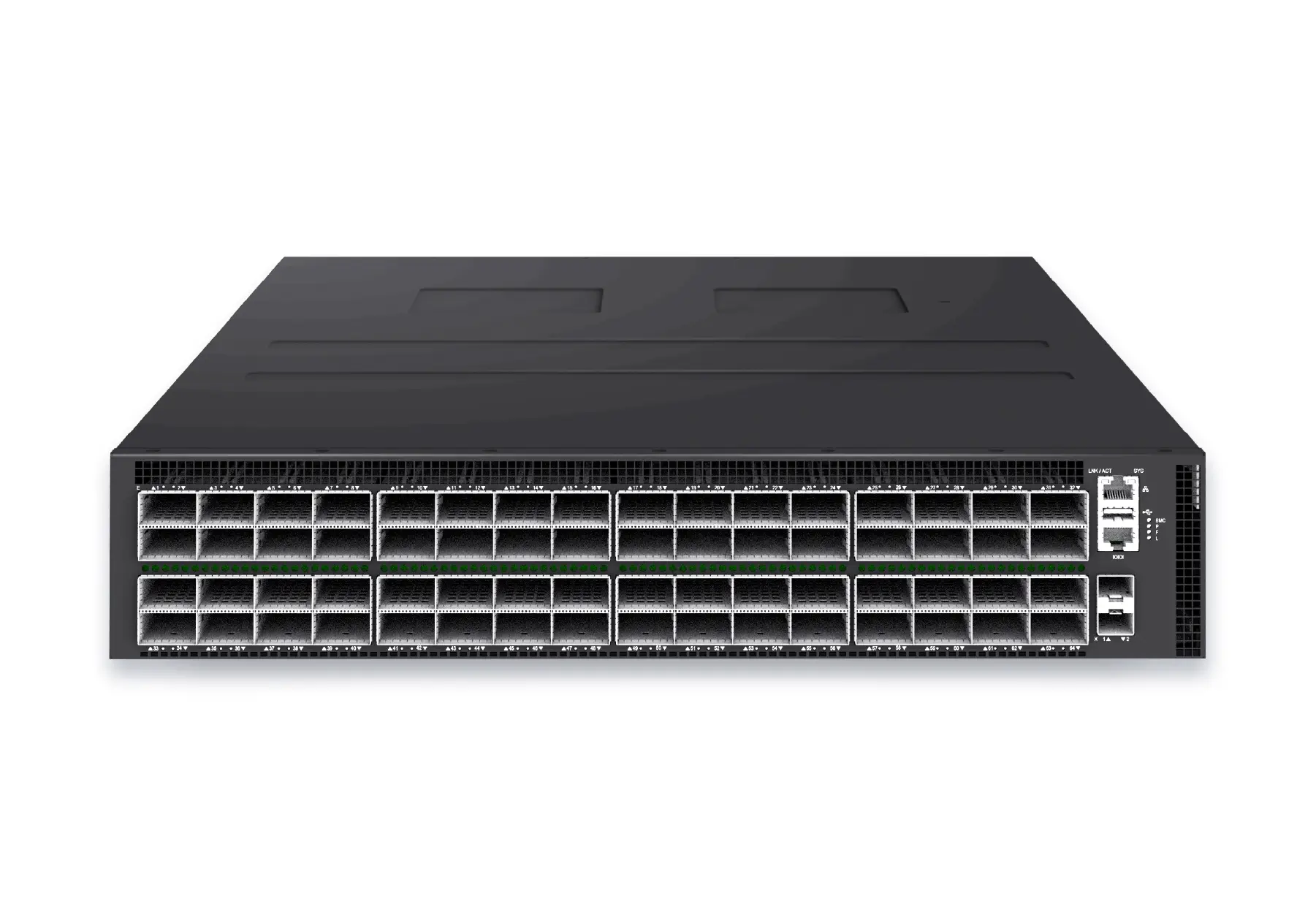 datacenter aiXS-DC-64X800-AI-G164-port 800G AI fabric switch for large-scale GPU clusters, HPC backbones, and ultra-high-throughput data center networks.View product
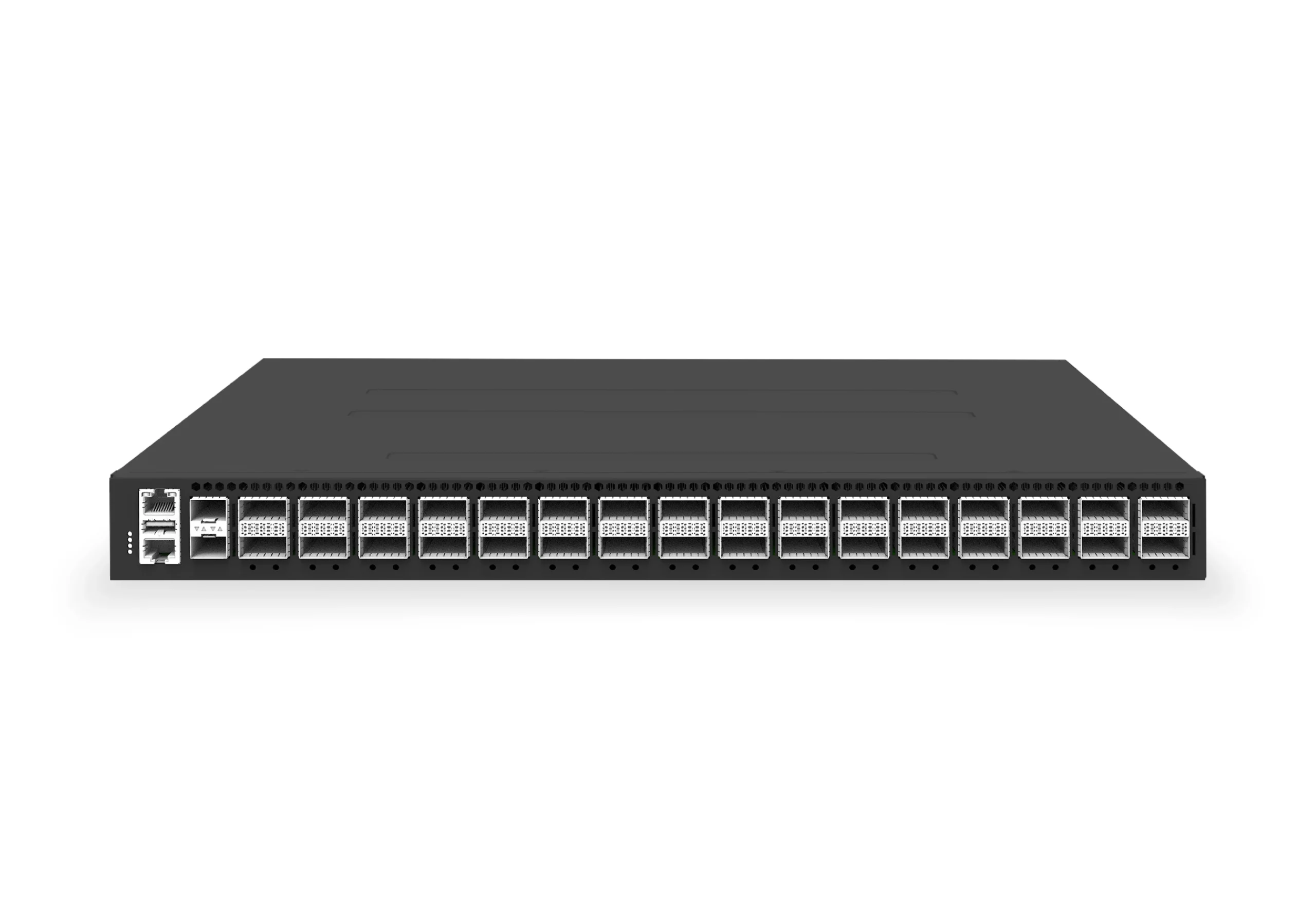 datacenter aiXS-DC-32X400-SP-G232-port 400G spine/core switch for high-capacity data center fabrics and AI-ready backbones.View product
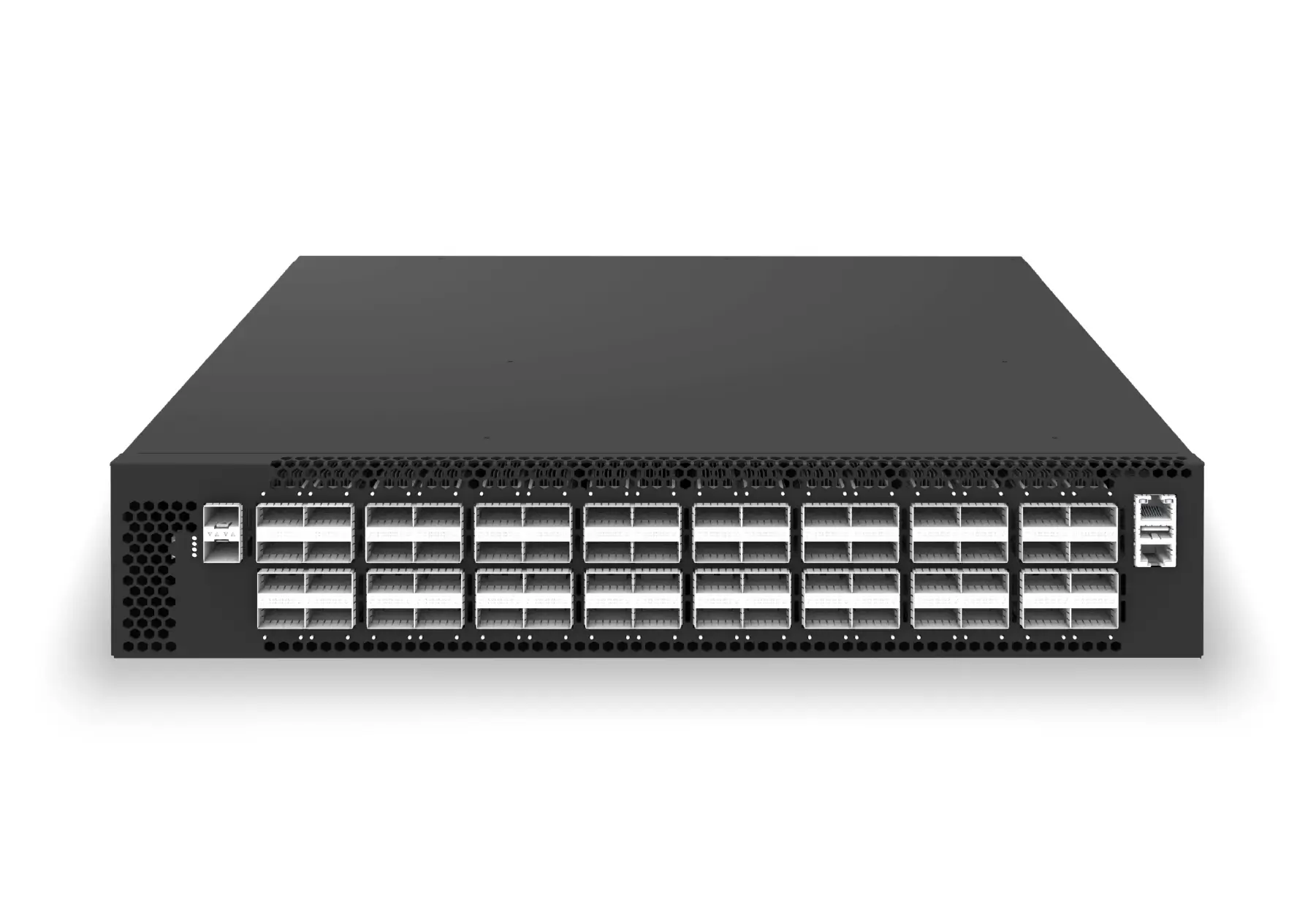 datacenter aiXS-DC-64X200-LS-G164-port 200G leaf/spine switch for high-bandwidth storage, compute, and scale-out data center fabrics.View product
Continue reading
Related articles
 Technical ArticleSONiC Switch Buying Guide for 400G and 800G Data Centers: Australian Enterprise PlaybookEngineering guidance on SONiC Switch Buying Guide for 400G and 800G Data Centers for Australian data centre buyers, covering form factor choice, link budgets, cabling.Read article
 Technical ArticleInfiniBand versus Ethernet for Private AI Infrastructure: An Australian Buyer Decision GuideEngineering guidance on InfiniBand versus Ethernet for Private AI Infrastructure for Australian campus teams, covering PoE budgets, access-layer resilience, migration.Read article
 Technical ArticleNVIDIA Spectrum-X vs SONiC Open Ethernet: What Australian AI Cluster Buyers Need to KnowA buyer-focused comparison of NVIDIA Spectrum-X and SONiC open Ethernet for Australian AI cluster teams weighing control, RoCE and lock-in.Read article